


Page 752 - Atlas of Creation Volume 1
P. 752
Every effort put into "generating a useful mutation" has resulted in failure. For decades, evolutionists car-
                  ried out many experiments to produce mutations in fruit flies as these insects reproduce very rapidly and so
                  mutations would show up quickly. Generation upon generation of these flies were mutated, yet no useful mu-
                  tation was ever observed. The evolutionist geneticist Gordon Taylor writes thus:

                       It is a striking, but not much mentioned fact that, though geneticists have been breeding fruit-flies for sixty
                       years or more in labs all around the world-flies which produce a new generation every eleven days-they have
                       never yet seen the emergence of a new species or even a new enzyme.        21
                       Another researcher, Michael Pitman, comments on the failure of the experiments carried out on fruit flies:

                       Morgan, Goldschmidt, Muller, and other geneticists have subjected generations of fruit flies to extreme condi-
                       tions of heat, cold, light, dark, and treatment by chemicals and radiation. All sorts of mutations, practically all
                       trivial or positively deleterious, have been produced. Man-made evolution? Not really: Few of the geneticists'
                       monsters could have survived outside the bottles they were bred in. In practice mutants die, are sterile, or tend
                       to revert to the wild type. 22
                       The same holds true for man. All mutations that have been observed in human beings have had deleterious

                  results. On this issue, evolutionists throw up a smokescreen and try to enlist examples of even such deleterious
                  mutations as "evidence for evolution". All mutations that take place in humans result in physical deformities,
                  in infirmities such as mongolism, Down syndrome, albinism, dwarfism or cancer. These mutations are pre-
                  sented in evolutionist textbooks as examples of "the evolutionary mechanism at work". Needless to say, a
                  process that leaves people disabled or sick cannot be "an evolutionary mechanism"-evolution is supposed to

                  produce forms that are better fitted to survive.
                       To summarise, there are three main reasons why mutations cannot be pressed into the service of support-
                  ing evolutionists' assertions:

                       l) The direct effect of mutations is harmful: Since they occur randomly, they almost always damage the
                  living organism that undergoes them. Reason tells us that unconscious intervention in a perfect and complex
                  structure will not improve that structure, but will rather impair it. Indeed, no "useful mutation" has ever been
                  observed.
                       2) Mutations add no new information to an organism's DNA: As a result of mutations, the particles mak-

                  ing up the genetic information are either torn from their places, destroyed, or carried off to different places.
                  Mutations cannot make a living thing acquire a new organ or a new trait. They only cause abnormalities like a
                  leg sticking out of the back, or an ear from the abdomen.

                       3) In order for a mutation to be transferred to the subsequent generation, it has to have taken place in
                  the reproductive cells of the organism: A random change that occurs in a cell or organ of the body cannot be
                  transferred to the next generation. For example, a human eye altered by the effects of radiation or by other
                                                                                           causes will not be passed on to subsequent
                                                                                           generations.

                                                                                               It is impossible for living beings to have
                                                                                           evolved, because there exists no mechanism in
                                                                                           nature that can cause evolution. Furthermore,

                                                                                           this conclusion agrees with the evidence of the
                                                                                           fossil record, which does not demonstrate the
                                                                                           existence of a process of evolution, but rather
                                                                                           just the contrary.


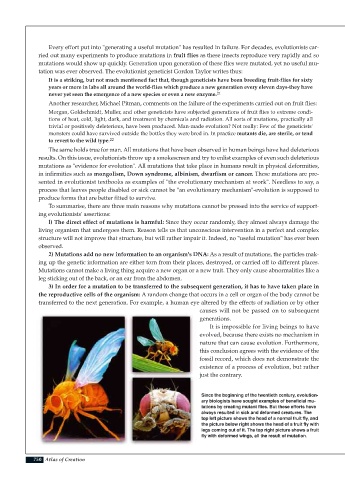
                                                                                           Since the beginning of the twentieth century, evolution-
                                                                                           ary biologists have sought examples of beneficial mu-
                                                                                           tations by creating mutant flies. But these efforts have
                                                                                           always resulted in sick and deformed creatures. The
                                                                                           top left picture shows the head of a normal fruit fly, and
                                                                                           the picture below right shows the head of a fruit fly with
                                                                                           legs coming out of it. The top right picture shows a fruit
                                                                                           fly with deformed wings, all the result of mutation.


                750 Atlas of Creation

