


Page 835 - Atlas of Creation Volume 1
P. 835
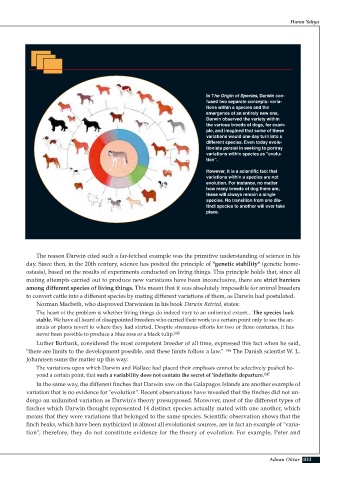
Variations within Species Do not Imply Evolution


                                                                                                                                   Harun Yahya


                                                                                              In The Origin of Species, Darwin con-
                                                                                              fused two separate concepts: varia-
                                                                                              tions within a species and the
                                                                                              emergence of an entirely new one.
                                                                                              Darwin observed the variety within
                                                                                              the various breeds of dogs, for exam-
                                                                                              ple, and imagined that some of these
                                                                                              variations would one day turn into a
                                                                                              different species. Even today evolu-
                                                                                              tionists persist in seeking to portray
                                                                                              variations within species as "evolu-
                                                                                              tion".

                                                                                              However, it is a scientific fact that
                                                                                              variations within a species are not
                                                                                              evolution. For instance, no matter
                                                                                              how many breeds of dog there are,
                                                                                              these will always remain a single
                                                                                              species. No transition from one dis-
                                                                                              tinct species to another will ever take
                                                                                              place.


                 The reason Darwin cited such a far-fetched example was the primitive understanding of science in his
             day. Since then, in the 20th century, science has posited the principle of "genetic stability" (genetic home-
             ostasis), based on the results of experiments conducted on living things. This principle holds that, since all

             mating attempts carried out to produce new variations have been inconclusive, there are strict barriers
             among different species of living things. This meant that it was absolutely impossible for animal breeders
             to convert cattle into a different species by mating different variations of them, as Darwin had postulated.
                 Norman Macbeth, who disproved Darwinism in his book Darwin Retried, states:

                 The heart of the problem is whether living things do indeed vary to an unlimited extent... The species look
                 stable. We have all heard of disappointed breeders who carried their work to a certain point only to see the an-
                 imals or plants revert to where they had started. Despite strenuous efforts for two or three centuries, it has
                 never been possible to produce a blue rose or a black tulip.  145
                 Luther Burbank, considered the most competent breeder of all time, expressed this fact when he said,

             "there are limits to the development possible, and these limits follow a law."           146  The Danish scientist W. L.
             Johannsen sums the matter up this way:
                 The variations upon which Darwin and Wallace had placed their emphasis cannot be selectively pushed be-
                 yond a certain point, that such a variability does not contain the secret of 'indefinite departure.   147

                 In the same way, the different finches that Darwin saw on the Galapagos Islands are another example of
             variation that is no evidence for "evolution". Recent observations have revealed that the finches did not un-
             dergo an unlimited variation as Darwin's theory presupposed. Moreover, most of the different types of

             finches which Darwin thought represented 14 distinct species actually mated with one another, which
             means that they were variations that belonged to the same species. Scientific observation shows that the
             finch beaks, which have been mythicized in almost all evolutionist sources, are in fact an example of "varia-
             tion"; therefore, they do not constitute evidence for the theory of evolution. For example, Peter and


                                                                                                                          Adnan Oktar    833

