


Page 840 - Atlas of Creation Volume 1
P. 840
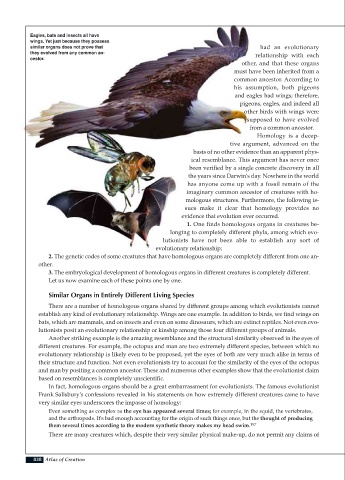
Eagles, bats and insects all have
               wings. Yet just because they possess
               similar organs does not prove that                                                                     had an evolutionary
               they evolved from any common an-                                                                     relationship with each
               cestor.
                                                                                                             other, and that these organs
                                                                                                          must have been inherited from a

                                                                                                          common ancestor. According to
                                                                                                          his assumption, both pigeons
                                                                                                          and eagles had wings; therefore,
                                                                                                             pigeons, eagles, and indeed all

                                                                                                               other birds with wings were
                                                                                                                supposed to have evolved
                                                                                                                 from a common ancestor.
                                                                                                                    Homology is a decep-

                                                                                                        tive argument, advanced on the
                                                                                        basis of no other evidence than an apparent phys-
                                                                                       ical resemblance. This argument has never once
                                                                                      been verified by a single concrete discovery in all

                                                                                     the years since Darwin's day. Nowhere in the world
                                                                                     has anyone come up with a fossil remain of the
                                                                                     imaginary common ancestor of creatures with ho-
                                                                                    mologous structures. Furthermore, the following is-

                                                                                    sues make it clear that homology provides no
                                                                                  evidence that evolution ever occurred.
                                                                                     1. One finds homologous organs in creatures be-
                                                                             longing to completely different phyla, among which evo-

                                                                          lutionists have not been able to establish any sort of
                                                                       evolutionary relationship;
                       2. The genetic codes of some creatures that have homologous organs are completely different from one an-
                  other.

                       3. The embryological development of homologous organs in different creatures is completely different.
                       Let us now examine each of these points one by one.


                       Similar Organs in Entirely Different Living Species

                       There are a number of homologous organs shared by different groups among which evolutionists cannot
                  establish any kind of evolutionary relationship. Wings are one example. In addition to birds, we find wings on

                  bats, which are mammals, and on insects and even on some dinosaurs, which are extinct reptiles. Not even evo-
                  lutionists posit an evolutionary relationship or kinship among those four different groups of animals.
                       Another striking example is the amazing resemblance and the structural similarity observed in the eyes of
                  different creatures. For example, the octopus and man are two extremely different species, between which no
                  evolutionary relationship is likely even to be proposed, yet the eyes of both are very much alike in terms of

                  their structure and function. Not even evolutionists try to account for the similarity of the eyes of the octopus
                  and man by positing a common ancestor. These and numerous other examples show that the evolutionist claim
                  based on resemblances is completely unscientific.

                       In fact, homologous organs should be a great embarrassment for evolutionists. The famous evolutionist
                  Frank Salisbury's confessions revealed in his statements on how extremely different creatures came to have
                  very similar eyes underscores the impasse of homology:
                       Even something as complex as the eye has appeared several times; for example, in the squid, the vertebrates,
                       and the arthropods. It's bad enough accounting for the origin of such things once, but the thought of producing
                       them several times according to the modern synthetic theory makes my head swim.           157

                       There are many creatures which, despite their very similar physical make-up, do not permit any claims of


                838 Atlas of Creation

