


Page 843 - Atlas of Creation Volume 1
P. 843
Harun Yahya


                 The Genetic and Embryological Impasse of Homology


                 In order for the evolutionist claim concerning "homology" to be taken seriously, similar (homologous)
             organs in different creatures should also be coded with similar (homologous) DNA codes. However, they are
             not. Similar organs are usually governed by very different genetic (DNA) codes. Furthermore, similar ge-

             netic codes in the DNA of different creatures are often associated with completely different organs.
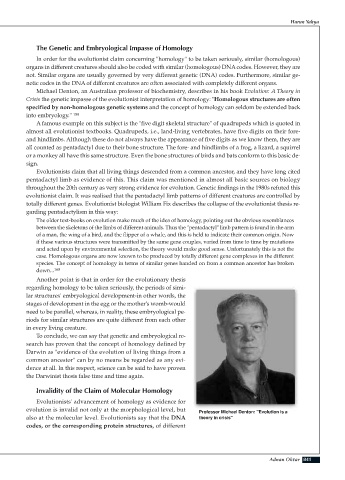
                 Michael Denton, an Australian professor of biochemistry, describes in his book Evolution: A Theory in
             Crisis the genetic impasse of the evolutionist interpretation of homology: "Homologous structures are often
             specified by non-homologous genetic systems and the concept of homology can seldom be extended back

             into embryology."    159
                 A famous example on this subject is the "five digit skeletal structure" of quadrupeds which is quoted in
             almost all evolutionist textbooks. Quadrupeds, i.e., land-living vertebrates, have five digits on their fore-
             and hindlimbs. Although these do not always have the appearance of five digits as we know them, they are

             all counted as pentadactyl due to their bone structure. The fore- and hindlimbs of a frog, a lizard, a squirrel
             or a monkey all have this same structure. Even the bone structures of birds and bats conform to this basic de-
             sign.
                 Evolutionists claim that all living things descended from a common ancestor, and they have long cited

             pentadactyl limb as evidence of this. This claim was mentioned in almost all basic sources on biology
             throughout the 20th century as very strong evidence for evolution. Genetic findings in the 1980s refuted this
             evolutionist claim. It was realised that the pentadactyl limb patterns of different creatures are controlled by
             totally different genes. Evolutionist biologist William Fix describes the collapse of the evolutionist thesis re-

             garding pentadactylism in this way:
                 The older text-books on evolution make much of the idea of homology, pointing out the obvious resemblances
                 between the skeletons of the limbs of different animals. Thus the "pentadactyl" limb pattern is found in the arm
                 of a man, the wing of a bird, and the flipper of a whale, and this is held to indicate their common origin. Now
                 if these various structures were transmitted by the same gene couples, varied from time to time by mutations
                 and acted upon by environmental selection, the theory would make good sense. Unfortunately this is not the
                 case. Homologous organs are now known to be produced by totally different gene complexes in the different
                 species. The concept of homology in terms of similar genes handed on from a common ancestor has broken
                 down... 160

                 Another point is that in order for the evolutionary thesis
             regarding homology to be taken seriously, the periods of simi-
             lar structures' embryological development-in other words, the
             stages of development in the egg or the mother's womb-would

             need to be parallel, whereas, in reality, these embryological pe-
             riods for similar structures are quite different from each other
             in every living creature.
                 To conclude, we can say that genetic and embryological re-

             search has proven that the concept of homology defined by
             Darwin as "evidence of the evolution of living things from a
             common ancestor" can by no means be regarded as any evi-
             dence at all. In this respect, science can be said to have proven

             the Darwinist thesis false time and time again.

                 Invalidity of the Claim of Molecular Homology


                 Evolutionists' advancement of homology as evidence for
             evolution is invalid not only at the morphological level, but                Professor Michael Denton: "Evolution is a
             also at the molecular level. Evolutionists say that the DNA                  theory in crisis"
             codes, or the corresponding protein structures, of different


                                                                                                                          Adnan Oktar    841

