


Page 845 - Atlas of Creation Volume 1
P. 845
Harun Yahya


                 the truth," says Claire Fraser, head of The Institute for Genomic Research (TIGR) in Rockville, Maryland.
                 Instead, the comparisons have yielded many versions of the tree of life that differ from the rRNA tree and
                 conflict with each other as well... 167
                 In short, as molecular biology advances, the homology concept loses more ground. Comparisons that

             have been made of proteins, rRNAs and genes reveal that creatures which are allegedly close relatives ac-
             cording to the theory of evolution are actually totally distinct from each other. A 1996 study using 88 protein
             sequences grouped rabbits with primates instead of rodents; a 1998 analysis of 13 genes in 19 animal species
             placed sea urchins among the chordates; and another 1998 study based on 12 proteins put cows closer to
             whales than to horses. Molecular biologist Jonathan Wells sums up the situation in 2000 in this way:

                 Inconsistencies among trees based on different molecules, and the bizarre trees that result from some molecu-
                 lar analyses, have now plunged molecular phylogeny into a crisis.     168
                 "Molecular phylogeny" is facing a crisis—which means that the theory of evolution also faces a crisis.

             (Phylogeny refers to the so-called "family relationships" among various living things and is the hypothetical
             basis of the theory of evolution.) Once again, science undermines the thesis that living things evolved from
             one another, demonstrating that all living groups were created separately.


                 The Myth of Embryological Recapitulation

                 What used to be called the "recapitulation theory" has long been eliminated from scientific literature, but

             it is still being presented as a scientific reality by some evolutionist publications. The term "recapitulation" is
             a condensation of the dictum "Ontogeny recapitulates phylogeny", put forward by the evolutionist biologist
             Ernst Haeckel at the end of the 19th century.
                 This theory of Haeckel's postulates that living embryos re-experience the evolutionary process that their
             pseudo-ancestors underwent. He theorised that during its development in its mother's womb, the human

             embryo first displayed the characteristics of a fish, and then those of a reptile, and finally those of a human.
                 It has since been proven that this theory is completely bogus. It is now known that the "gills" that sup-
             posedly appear in the early stages of the human embryo are in fact the initial phases of the middle-ear canal,

             parathyroid, and thymus. The part of the embryo that was likened to the "egg yolk pouch" turns out to be a
             pouch that produces blood for the infant. The part that had been identified as a "tail" by Haeckel and his fol-
             lowers is in fact the backbone, which resembles a tail only because it takes shape before the legs do.
                 These are universally acknowledged facts in the scientific world, and are accepted even by evolutionists
             themselves. George Gaylord Simpson, one of the founders of neo-Darwinism, writes:

                 Haeckel misstated the evolutionary principle involved. It is now firmly established that ontogeny does not
                 repeat phylogeny.   169

                 In an article published in American Scientist, we read:
                 Surely the biogenetic law is as dead as a doornail. It was fi-
                 nally exorcised from biology textbooks in the fifties. As a topic
                 of serious theoretical inquiry it was extinct in the twenties…  170
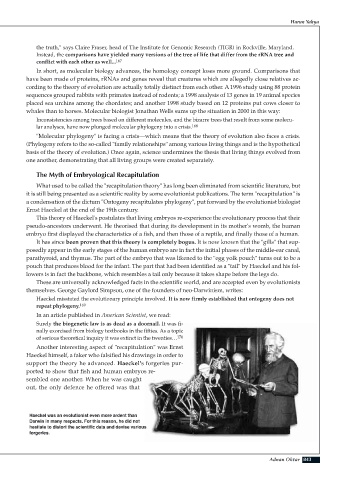
                 Another interesting aspect of "recapitulation" was Ernst

             Haeckel himself, a faker who falsified his drawings in order to
             support the theory he advanced. Haeckel's forgeries pur-
             ported to show that fish and human embryos re-

             sembled one another. When he was caught
             out, the only defence he offered was that


              Haeckel was an evolutionist even more ardent than
              Darwin in many respects. For this reason, he did not
              hesitate to distort the scientific data and devise various
              forgeries.


                                                                                                                          Adnan Oktar    843

