


Page 842 - Atlas of Creation Volume 1
P. 842
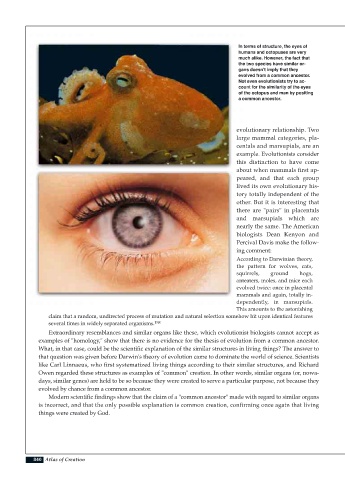
In terms of structure, the eyes of
                                                                                                            humans and octopuses are very
                                                                                                            much alike. However, the fact that
                                                                                                            the two species have similar or-
                                                                                                            gans doesn't imply that they
                                                                                                            evolved from a common ancestor.
                                                                                                            Not even evolutionists try to ac-
                                                                                                            count for the similarity of the eyes
                                                                                                            of the octopus and man by positing
                                                                                                            a common ancestor.


                                                                                                           evolutionary relationship. Two
                                                                                                           large mammal categories, pla-
                                                                                                           centals and marsupials, are an
                                                                                                           example. Evolutionists consider

                                                                                                           this distinction to have come
                                                                                                           about when mammals first ap-
                                                                                                           peared, and that each group

                                                                                                           lived its own evolutionary his-
                                                                                                           tory totally independent of the
                                                                                                           other. But it is interesting that
                                                                                                           there are "pairs" in placentals
                                                                                                           and marsupials which are

                                                                                                           nearly the same. The American
                                                                                                           biologists Dean Kenyon and
                                                                                                           Percival Davis make the follow-

                                                                                                           ing comment:
                                                                                                           According to Darwinian theory,
                                                                                                           the pattern for wolves, cats,
                                                                                                           squirrels,     ground       hogs,
                                                                                                           anteaters, moles, and mice each
                                                                                                           evolved twice: once in placental
                                                                                                           mammals and again, totally in-
                                                                                                           dependently, in marsupials.
                                                                                                           This amounts to the astonishing
                       claim that a random, undirected process of mutation and natural selection somehow hit upon identical features
                       several times in widely separated organisms.   158
                       Extraordinary resemblances and similar organs like these, which evolutionist biologists cannot accept as

                  examples of "homology," show that there is no evidence for the thesis of evolution from a common ancestor.
                  What, in that case, could be the scientific explanation of the similar structures in living things? The answer to
                  that question was given before Darwin's theory of evolution came to dominate the world of science. Scientists
                  like Carl Linnaeus, who first systematized living things according to their similar structures, and Richard

                  Owen regarded these structures as examples of "common" creation. In other words, similar organs (or, nowa-
                  days, similar genes) are held to be so because they were created to serve a particular purpose, not because they
                  evolved by chance from a common ancestor.
                       Modern scientific findings show that the claim of a "common ancestor" made with regard to similar organs

                  is incorrect, and that the only possible explanation is common creation, confirming once again that living
                  things were created by God.


                840 Atlas of Creation

