


Page 838 - Atlas of Creation Volume 1
P. 838
and therefore a loss of information.
                                                                                               The main point is that (Evolution) cannot be
                                                                                         achieved by mutations of this sort, no matter how
                                                                                     many of them there are. Evolution cannot be built by
                                                                                   accumulating mutations that only degrade speci-
                                                                                  ficity. 151
                                                                                    To sum up, a mutation impinging on a bacterium's
                                                                              ribosome makes that bacterium resistant to streptomycin.

                                                                          The reason for this is the "decomposition" of the ribosome by
                                                                     mutation. That is, no new genetic information is added to the bac-
                                                                  terium. On the contrary, the structure of the ribosome is decom-
                                                                  posed, that is to say, the bacterium becomes "disabled". (Also, it has

                                                                   been discovered that the ribosome of the mutated bacterium is less
                                                                     functional than that of normal bacterium). Since this "disability"
                                                                       prevents the antibiotic from attaching onto the ribosome, "an-
                                                                         tibiotic resistance" develops.

                                                                               Finally, there is no example of mutation that "develops
                                                                            the genetic information".
                                                                                The same situation holds true for the immunity that in-
                                                                     sects develop to DDT and similar insecticides. In most of these in-

                                                       stances, immunity genes that already exist are used. The evolutionist biologist
                                                       Francisco Ayala admits this fact, saying, "The genetic variants required for re-
                                                       sistance to the most diverse kinds of pesticides were apparently present in
                                                       every one of the populations exposed to these man-made compounds."                    152

                                                  Some other examples explained by mutation, just as with the ribosome mutation
                                               mentioned above, are phenomena that cause "genetic information deficit" in insects.
                                                    In this case, it cannot be claimed that the immunity mechanisms in bacteria and
                                                insects constitute evidence for the theory of evolution. That is because the theory of

                                                 evolution is based on the assertion that living things develop through mutations.
                                                  However, Spetner explains that neither antibiotic immunity nor any other biologi-
                                                  cal phenomena indicate such an example of mutation:

                                                 The mutations needed for macroevolution have never been observed. No random mu-
                                                 tations that could represent the mutations required by Neo-Darwinian Theory that have
                                              been examined on the molecular level have added any information. The question I address
                                            is: Are the mutations that have been observed the kind the theory needs for support? The an-
                                           swer turns out to be NO!  153


                                          The Fallacy of Vestigial Organs

                                              For a long time, the concept of "vestigial organs" appeared frequently in evolutionist
                                         literature as "evidence" of evolution. Eventually, it was silently put to rest when this was
                                        proved to be invalid. But some evolutionists still believe in it, and from time to time some-

                                       one will try to advance "vestigial organs" as important evidence of evolution.
                                           The notion of "vestigial organs" was first put forward a century ago. As evolutionists
                                      would have it, there existed in the bodies of some creatures a number of non-functional or-
                                     gans. These had been inherited from progenitors and had gradually become vestigial from

                                      lack of use.


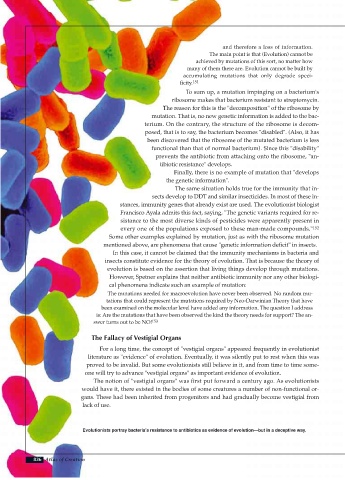
                                      Evolutionists portray bacteria's resistance to antibiotics as evidence of evolution—but in a deceptive way.


                836 Atlas of Creation

