


Page 65 - Five Forces of Americanisation Richard Hooke 04072025 final post SDR1
P. 65
The UK Defence Industry in the 21  Century
                                                                        st
                                            The Five Forces of Americanisation

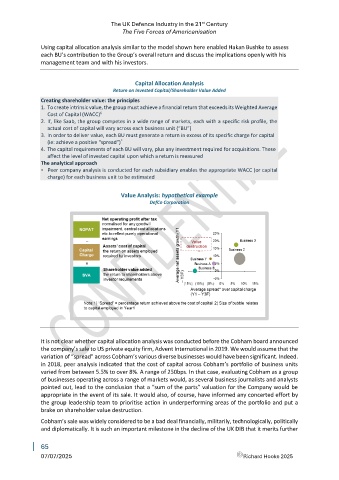
               Using capital allocation analysis similar to the model shown here enabled Hakan Bushke to assess
               each BU’s contribution to the Group’s overall return and discuss the implications openly with his
               management team and with his investors.


                                                Capital Allocation Analysis
                                         Return on Invested Capital/Shareholder Value Added

               Creating shareholder value: the principles
               1. To create intrinsic value, the group must achieve a financial return that exceeds its Weighted Average
                                    6
                  Cost of Capital (WACC)
               2. If, like Saab, the group competes in a wide range of markets, each with a specific risk profile, the
                  actual cost of capital will vary across each business unit (“BU”)
               3. In order to deliver value, each BU must generate a return in excess of its specific charge for capital
                                           *
                  (ie: achieve a positive “spread”)
               4. The capital requirements of each BU will vary, plus any investment required for acquisitions. These
                  affect the level of invested capital upon which a return is measured
               The analytical approach
               •  Peer company analysis is conducted for each subsidiary enables the appropriate WACC (or capital
                  charge) for each business unit to be estimated

                                            Value Analysis: hypothetical example
                                                      DefCo Corporation


               It is not clear whether capital allocation analysis was conducted before the Cobham board announced
               the company’s sale to US private equity firm, Advent International in 2019. We would assume that the
               variation of “spread” across Cobham’s various diverse businesses would have been significant. Indeed.
               in 2018, peer analysis indicated that the cost of capital across Cobham’s portfolio of business units
               varied from between 5.5% to over 8%. A range of 250bps. In that case, evaluating Cobham as a group
               of businesses operating across a range of markets would, as several business journalists and analysts
               pointed out, lead to the conclusion that a “sum of the parts” valuation for the Company would be
               appropriate in the event of its sale. It would also, of course, have informed any concerted effort by
               the group leadership team to prioritise action in underperforming areas of the portfolio and put a
               brake on shareholder value destruction.

               Cobham’s sale was widely considered to be a bad deal financially, militarily, technologically, politically
               and diplomatically. It is such an important milestone in the decline of the UK DIB that it merits further


               65
               07/07/2025                                                                                                                                   Richard Hooke 2025

