


Page 62 - Five Forces of Americanisation Richard Hooke 04072025 final post SDR1
P. 62
The UK Defence Industry in the 21  Century
                                                                        st
                                            The Five Forces of Americanisation

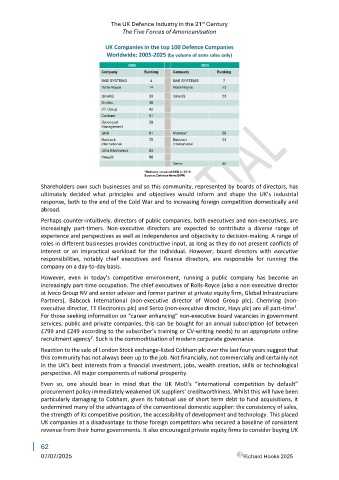
                                      UK Companies in the top 100 Defence Companies
                                      Worldwide: 2005-2025 (by volume of arms sales only)


               Shareholders own such businesses and so this community, represented by boards of directors, has
               ultimately  decided  what  principles  and  objectives  would  inform  and  shape  the  UK’s  industrial
               response, both to the end of the Cold War and to increasing foreign competition domestically and
               abroad.

               Perhaps counter-intuitively, directors of public companies, both executives and non-executives, are
               increasingly  part-timers.  Non-executive  directors  are  expected  to  contribute  a  diverse  range  of
               experience and perspectives as well as independence and objectivity to decision-making. A range of
               roles in different businesses provides constructive input, as long as they do not present conflicts of
               interest  or  an  impractical  workload  for  the  individual.  However,  board  directors  with  executive
               responsibilities,  notably  chief  executives  and  finance  directors,  are  responsible  for  running  the
               company on a day-to-day basis.
               However,  even  in  today’s  competitive  environment,  running  a  public  company  has  become  an
               increasingly part-time occupation. The chief executives of Rolls-Royce (also a non-executive director
               at Iveco Group NV and senior adviser and former partner at private equity firm, Global Infrastructure
               Partners),  Babcock  International  (non-executive  director  of  Wood  Group  plc),  Chemring  (non-
                                                                                                        2
               executive director, TT Electronics plc) and Serco (non-executive director, Hays plc) are all part-time .
               For those seeking information on “career enhancing” non-executive board vacancies in government
               services, public and private companies, this can be bought for an annual subscription (of between
               £799 and £249 according to the subscriber’s training or CV-writing needs) to an appropriate online
                                 2
               recruitment agency . Such is the commoditisation of modern corporate governance.
               Reaction to the sale of London Stock exchange-listed Cobham plc over the last four years suggest that
               this community has not always been up to the job. Not financially, not commercially and certainly not
               in the UK’s best interests from a financial investment, jobs, wealth creation, skills or technological
               perspective. All major components of national prosperity.

               Even  so,  one  should  bear  in  mind  that  the  UK  MoD’s  “international  competition  by  default”
               procurement policy immediately weakened UK suppliers’ creditworthiness. Whilst this will have been
               particularly damaging to Cobham, given its habitual use of short term debt to fund acquisitions, it
               undermined many of the advantages of the conventional domestic supplier: the consistency of sales,
               the strength of its competitive position, the accessibility of development and technology. This placed
               UK companies at a disadvantage to those foreign competitors who secured a baseline of consistent
               revenue from their home governments. It also encouraged private equity firms to consider buying UK

               62
               07/07/2025                                                                                                                                   Richard Hooke 2025

