


Page 15 - Jurnal Penelitian MTsN 6 Jakarta
P. 15
applications, this research seeks to         2.1 System Design
                        provide a sustainable, efficient, and
                        user-friendly solution for managing          The  system  design  involves  the
                        household     organic     waste     in       development  of  hardware  and
                        Indonesia.  It  is  hoped  that  this        software  components  to  support
                        innovation will not only address the         automated       composting.      The
                        challenges  of  waste  management            primary    hardware     components
                                                                     include:
                        but  also  foster  a  cultural  shift
                        towards viewing organic waste as a
                        valuable resource.

                        By promoting the use of IoT in waste
                        management,        this     research
                        supports Indonesia’s broader goals
                        of   environmental     sustainability,
                        greenhouse  gas  reduction,  and
                        improved  public  health.  Ultimately,
                        the  implementation  of  IoT-based
                        composting bins has the potential to
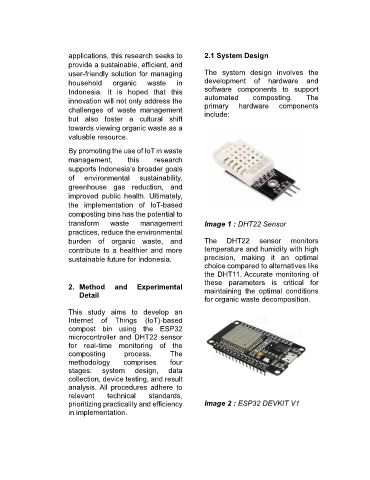
                        transform    waste     management            Image 1 : DHT22 Sensor
                        practices, reduce the environmental
                        burden  of  organic  waste,  and             The    DHT22      sensor    monitors
                        contribute  to a  healthier  and  more       temperature and humidity with high
                        sustainable future for Indonesia.            precision,  making  it  an  optimal
                                                                     choice compared to alternatives like
                                                                     the DHT11. Accurate monitoring of
                                                                     these  parameters  is  critical  for
                        2.  Method     and    Experimental           maintaining  the  optimal  conditions
                           Detail                                    for organic waste decomposition.

                        This  study  aims  to  develop  an
                        Internet  of  Things  (IoT)-based
                        compost  bin  using  the  ESP32
                        microcontroller  and  DHT22  sensor
                        for  real-time  monitoring  of  the
                        composting        process.       The
                        methodology       comprises      four
                        stages:    system     design,    data
                        collection, device testing, and result
                        analysis. All  procedures  adhere  to
                        relevant     technical    standards,
                        prioritizing practicality and efficiency     Image 2 : ESP32 DEVKIT V1
                        in implementation.

