


Page 348 - “O‘ZBEKISTON – 2030 STRATEGIYASI: AMALGA OSHIRILAYOTGAN ISLOHOTLAR TAHLILI, MUAMMOLAR VA YECHIMLAR”
P. 348
3. Case Study Analysis
                  Three representative case studies were selected for in-depth evaluation:

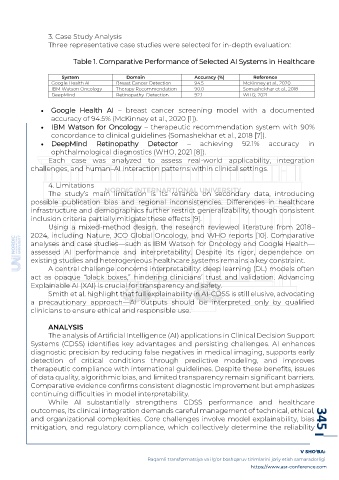
                           Table 1. Comparative Performance of Selected AI Systems in Healthcare

                       System                Domain                  Accuracy (%)         Reference
                   Google Health AI       Breast Cancer Detection    94.5             McKinney et al., 2020
                   IBM Watson Oncology    Therapy Recommendation     90.0             Somashekhar et al., 2018
                   DeepMind               Retinopathy  Detection     92.1             WHO, 2021

               •  Google  Health  AI  –  breast  cancer  screening  model  with  a  documented
                   accuracy of 94.5% (McKinney et al., 2020 [1]).
               •  IBM  Watson  for  Oncology  –  therapeutic  recommendation system  with  90%
                   concordance to clinical guidelines (Somashekhar et al., 2018 [7]).
               •  DeepMind         Retinopathy       Detector      –   achieving      92.1%    accuracy      in
                   ophthalmological diagnostics (WHO, 2021 [8]).
                  Each  case  was  analyzed  to  assess  real-world  applicability,  integration
            challenges, and human–AI interaction patterns within clinical settings.

                  4. Limitations
                  The  study’s  main  limitation  is  its  reliance  on  secondary  data,  introducing
            possible  publication  bias  and  regional  inconsistencies.  Differences  in  healthcare
            infrastructure and demographics further restrict generalizability, though consistent
            inclusion criteria partially mitigate these effects [9].
                  Using  a  mixed-method  design,  the  research  reviewed  literature  from  2018–
            2024, including Nature, JCO Global Oncology, and WHO reports [10]. Comparative
            analyses and case studies—such as IBM Watson for Oncology and Google Health—
            assessed  AI  performance  and  interpretability.  Despite  its  rigor,  dependence  on
            existing studies and heterogeneous healthcare systems remains a key constraint.
                  A central challenge concerns interpretability: deep learning (DL) models often
            act  as  opaque  “black  boxes,”  hindering  clinicians’  trust  and  validation.  Advancing
            Explainable AI (XAI) is crucial for transparency and safety.
                  Smith et al. highlight that full explainability in AI-CDSS is still elusive, advocating
            a  precautionary  approach—AI  outputs  should  be  interpreted  only  by  qualified
            clinicians to ensure ethical and responsible use.

                  ANALYSIS
                  The analysis of Artificial Intelligence (AI) applications in Clinical Decision Support
            Systems  (CDSS)  identifies  key  advantages  and  persisting  challenges.  AI  enhances
            diagnostic precision by reducing false negatives in medical imaging, supports early
            detection  of  critical  conditions  through  predictive  modeling,  and  improves
            therapeutic compliance with international guidelines. Despite these benefits, issues
            of data quality, algorithmic bias, and limited transparency remain significant barriers.
            Comparative evidence confirms consistent diagnostic improvement but emphasizes
            continuing difficulties in model interpretability.
                  While  AI  substantially  strengthens  CDSS  performance  and  healthcare
            outcomes, its clinical integration demands careful management of technical, ethical,
            and organizational complexities. Core challenges involve model explainability, bias                 345
            mitigation, and regulatory compliance, which collectively determine the reliability


                                                                                                           V SHO‘BA:

                                                     Raqamli transformatsiya va ilg‘or boshqaruv tizimlarini joriy etish samaradorligi

                                                                                         https://www.asr-conference.com

