


Page 350 - “O‘ZBEKISTON – 2030 STRATEGIYASI: AMALGA OSHIRILAYOTGAN ISLOHOTLAR TAHLILI, MUAMMOLAR VA YECHIMLAR”
P. 350
processing (NLP), and deep learning (DL)—enhance accuracy, efficiency, and clinical
            decision quality.
                  Findings  show  a  15–20%  gain  in  diagnostic  accuracy,  driven  by  AI’s  ability  to
            detect  complex  patterns.  Convolutional  neural  networks  (CNNs)  analyze  medical
            images  with  precision  comparable  to  experts,  reducing  diagnostic  errors  and
            enabling earlier intervention. In predictive analytics, AI systems continuously process
            real-time  data  to  forecast  risks  and  guide  preventive  measures,  lowering
            complication and mortality rates.
                  Therapeutically,  AI-CDSS  reinforce  evidence-based  medicine  by  synthesizing
            guidelines,  trials,  and  patient  histories  to  tailor  treatments  to  individual  profiles,
            supporting precision medicine and efficient resource use. Comparative data (Table 1)
            reveal that AI-CDSS surpass traditional systems in accuracy, intervention time, and
            clinician adherence—representing a paradigm shift in healthcare.
                  Nonetheless,  effective  adoption  requires  attention  to  data  integrity,  ethical
            oversight, and model transparency. The study stresses interdisciplinary collaboration,
            clinician training, and algorithm validation to ensure safety and equity. Overcoming
            technical and organizational barriers is essential to fully realize the transformative
            potential of AI-integrated CDSS [15].


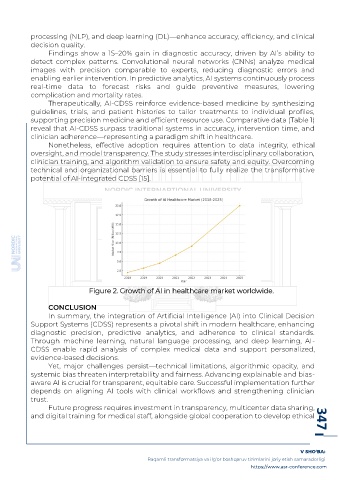
                                Figure 2. Growth of AI in healthcare market worldwide.

                  CONCLUSION
                  In summary, the integration of Artificial Intelligence (AI) into Clinical Decision
            Support Systems (CDSS) represents a pivotal shift in modern healthcare, enhancing
            diagnostic  precision,  predictive  analytics,  and  adherence  to  clinical  standards.
            Through  machine  learning,  natural  language  processing,  and  deep  learning,  AI-
            CDSS  enable  rapid  analysis  of  complex  medical  data  and  support  personalized,
            evidence-based decisions.
                  Yet,  major  challenges  persist—technical  limitations,  algorithmic  opacity,  and
            systemic bias threaten interpretability and fairness. Advancing explainable and bias-
            aware AI is crucial for transparent, equitable care. Successful implementation further
            depends  on  aligning  AI  tools  with  clinical  workflows  and  strengthening  clinician
            trust.
                  Future progress requires investment in transparency, multicenter data sharing,
            and digital training for medical staff, alongside global cooperation to develop ethical             347


                                                                                                           V SHO‘BA:

                                                     Raqamli transformatsiya va ilg‘or boshqaruv tizimlarini joriy etish samaradorligi

                                                                                         https://www.asr-conference.com

