


Page 349 - “O‘ZBEKISTON – 2030 STRATEGIYASI: AMALGA OSHIRILAYOTGAN ISLOHOTLAR TAHLILI, MUAMMOLAR VA YECHIMLAR”
P. 349
and  acceptance  of  AI-enabled  tools.  Deep  learning  models,  in  particular,  often
            function  as  “black  boxes,”  complicating  clinicians’  understanding  of  underlying
            decision processes and limiting trust in AI recommendations.
                  Another  critical  issue  concerns  generalizability  across  heterogeneous
            populations  and  data  environments.  Algorithms  trained  on  unbalanced  datasets
            may produce inconsistent results and reinforce healthcare disparities. Obermeyer et
            al. [11] demonstrated the presence of racial bias in clinical AI systems, underscoring
            the necessity for equitable data collection, transparent validation, and continuous
            algorithm auditing to ensure fairness and inclusivity in AI-supported CDSS.
                  Legal  and  ethical  compliance  also  poses  major  constraints.  Adhering  to
            frameworks such as the Health Insurance Portability and Accountability Act (HIPAA)
            and the General Data Protection Regulation (GDPR) is essential for maintaining data
            privacy and patient trust. Moreover, the complexity of medical device certification,
            software  validation,  and  CDSS  authorization  processes  hinders  large-scale
            implementation.  These  regulatory  and  ethical  considerations  represent  central
            challenges  for  developers  and  healthcare  organizations  seeking  to  deploy  AI
            solutions safely and responsibly [12].


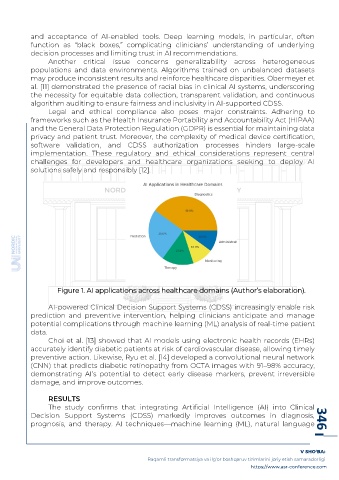
                     Figure 1. AI applications across healthcare domains (Author’s elaboration).

                  AI-powered Clinical Decision Support Systems (CDSS) increasingly enable risk
            prediction  and  preventive  intervention,  helping  clinicians  anticipate  and  manage
            potential complications through machine learning (ML) analysis of real-time patient
            data.
                  Choi et al. [13] showed that AI models using electronic health records (EHRs)
            accurately identify diabetic patients at risk of cardiovascular disease, allowing timely
            preventive action. Likewise, Ryu et al. [14] developed a convolutional neural network
            (CNN) that predicts diabetic retinopathy from OCTA images with 91–98% accuracy,
            demonstrating  AI’s  potential  to  detect  early  disease  markers,  prevent  irreversible
            damage, and improve outcomes.

                  RESULTS
                  The  study  confirms  that  integrating  Artificial  Intelligence  (AI)  into  Clinical
            Decision  Support  Systems  (CDSS)  markedly  improves  outcomes  in  diagnosis,
            prognosis,  and  therapy.  AI  techniques—machine  learning  (ML),  natural  language               346


                                                                                                           V SHO‘BA:

                                                     Raqamli transformatsiya va ilg‘or boshqaruv tizimlarini joriy etish samaradorligi

                                                                                         https://www.asr-conference.com

