


Page 265 - RAQAMLI TRANSFORMATSIYA DAVRIDA PEDAGOGIK TA’LIMNI RIVOJLANTIRISH ISTIQBOLLARI
P. 265
advanced  practice.  Encouraging  students  to  “stay  human  in  the  loop”  is  often
            recommended.
                  Building  AI  literacy  and  critical  appraisal  skills  are  necessary.  Using  AI  tools
            under  supervision  helps  students  understand  strengths,  limitations,  biases,  and
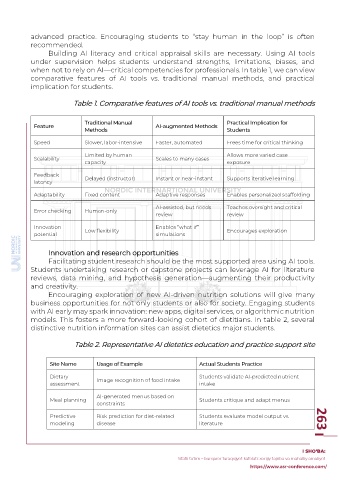
            when not to rely on AI—critical competencies for professionals. In table 1, we can view
            comparative  features  of  AI  tools  vs.  traditional  manual  methods,  and  practical
            implication for students.

                           Table 1. Comparative features of AI tools vs. traditional manual methods

                               Traditional Manual                                Practical Implication for
             Feature                                    AI-augmented Methods
                               Methods                                           Students
             Speed             Slower, labor-intensive   Faster, automated       Frees time for critical thinking

                               Limited by human                                  Allows more varied case
             Scalability                                Scales to many cases
                               capacity                                          exposure

             Feedback          Delayed (instructor)     Instant or near-instant   Supports iterative learning
             latency

             Adaptability      Fixed content            Adaptive responses       Enables personalized scaffolding

                                                        AI-assisted, but needs   Teaches oversight and critical
             Error checking    Human-only
                                                        review                   review
             Innovation        Low flexibility          Enables “what-if”        Encourages exploration
             potential                                  simulations

                  Innovation and research opportunities
                  Facilitating student research should be the most supported area using AI tools.
            Students undertaking  research or  capstone  projects can leverage  AI  for  literature
            reviews,  data  mining,  and  hypothesis  generation—augmenting  their  productivity
            and creativity.
                  Encouraging  exploration  of  new  AI-driven  nutrition  solutions  will  give  many
            business opportunities for not only students or also for society. Engaging students
            with AI early may spark innovation: new apps, digital services, or algorithmic nutrition
            models. This fosters a more forward-looking cohort of dietitians. In table 2, several
            distinctive nutrition information sites can assist dietetics major students.

                           Table 2. Representative AI dietetics education and practice support site


                   Site Name       Usage of Example                    Actual Students Practice

                   Dietary         Image recognition of food intake    Students validate AI-predicted nutrient
                   assessment                                          intake
                                   AI-generated menus based on
                   Meal planning                                       Students critique and adapt menus
                                   constraints
                   Predictive      Risk prediction for diet-related    Students evaluate model output vs.
                   modeling        disease                             literature                               263


                                                                                                           I SHO‘BA:

                                                               Sifatli ta’lim – barqaror taraqqiyot kafolati: xorijiy tajriba va mahalliy amaliyot

                                                                                         https://www.asr-conference.com/

