


Page 573 - RAQAMLI TRANSFORMATSIYA DAVRIDA PEDAGOGIK TA’LIMNI RIVOJLANTIRISH ISTIQBOLLARI
P. 573
regardless of personal differences like gender, disability, socioeconomic background,
            or  ethnicity.   It  has  evolved  from  the  concept  of  'integration,'  which  focused  on
                          1
            incorporating specific groups like students with disabilities into the existing system,
            to a broader paradigm of 'inclusion' that requires the entire educational system to
            adapt to the diversity of all students.  This is because inclusive education is a crucial
                                                       1
            process  and  tool  for  building  an  inclusive  society,  a  society  where  all  members
            participate and have opportunities without discrimination.  The experience of mutual
                                                                                 1
            respect and collaboration learned in the classroom is expected to contribute to a
            more cohesive and integrated society in the future.
                                                                        1

                  RESEARCH METHODOLOGY
                   This  study  comprehensively  reviewed  domestic  and  international  prior
            research, as well as reports and related materials from international organizations like
            UNESCO, to establish the concept and significance of inclusive education.  The core
                                                                                                    1
            of the study is a detailed case review based on the author's experience teaching at a
            local university in Uzbekistan.  Through this case, the study empirically presents the
                                               1
            application and effectiveness of inclusive education strategies. In addition, it analyzes
            policies  and  statistical  data  on  multicultural  education  and  special  education  in
            South  Korea  and  compares  them  with  the  case  of  Uzbekistan,  thereby  deeply
            deriving the commonalities and differences between the two countries.                1
                   Implementation Cases and Analysis of Inclusive Education
                   Practices and Challenges of Inclusion in Multicultural Classrooms in Uzbekistan
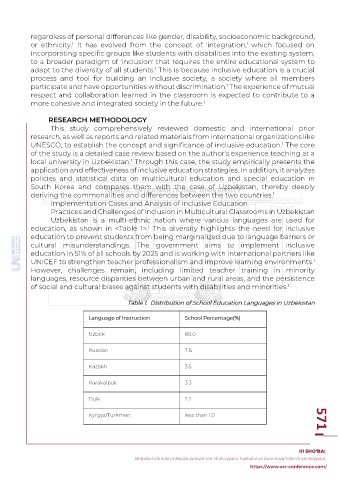
                   Uzbekistan  is  a  multi-ethnic  nation  where  various  languages  are  used  for
            education,  as  shown  in  <Table  1>.   This  diversity  highlights  the  need  for  inclusive
                                                     1
            education to prevent students from being marginalized due to language barriers or
            cultural  misunderstandings.  The  government  aims  to  implement  inclusive
            education in 51% of all schools by 2025 and is working with international partners like
            UNICEF to strengthen teacher professionalism and improve learning environments.
                                                                                                               1
            However,  challenges  remain,  including  limited  teacher  training  in  minority
            languages, resource disparities between urban and rural areas, and the persistence
            of social and cultural biases against students with disabilities and minorities.          1

                                              Table 1.  Distribution of School Education Languages in Uzbekistan

                                Language of Instruction           School Percentage(%)
                                Uzbek                             80.0

                                Russian                           7.6

                                Kazakh                            3.5

                                Karakalpak                        3.3

                                Tajik                             2.2

                                Kyrgyz/Turkmen                    less than 1.0
                                                                                                                571


                                                                                                          III SHO‘BA:

                                                Inklyuziv ta’limdan inklyuziv jamiyat sari: strategiyalar, tajribalar va zamonaviy ta’lim texnologiyalar

                                                                                         https://www.asr-conference.com/

