


Page 575 - RAQAMLI TRANSFORMATSIYA DAVRIDA PEDAGOGIK TA’LIMNI RIVOJLANTIRISH ISTIQBOLLARI
P. 575
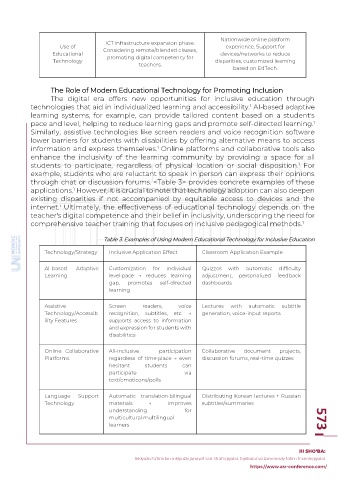
Nationwide online platform
                                      ICT infrastructure expansion phase.
                      Use of         Considering remote/blended classes,        experience. Support for
                   Educational         promoting digital competency for       devices/networks to reduce
                    Technology                                               disparities, customized learning
                                                  teachers.
                                                                                   based on EdTech.

                   The Role of Modern Educational Technology for Promoting Inclusion
                   The  digital  era  offers  new  opportunities  for  inclusive  education  through
            technologies that aid in individualized learning and accessibility.  AI-based adaptive
                                                                                         1
            learning  systems,  for  example,  can  provide  tailored  content  based  on  a  student's
            pace and level, helping to reduce learning gaps and promote self-directed learning.
                                                                                                               1
            Similarly, assistive technologies like screen readers and voice recognition software
            lower barriers for students with disabilities by offering alternative means to access
            information and express themselves.  Online platforms and collaborative tools also
                                                        1
            enhance  the  inclusivity  of  the  learning  community  by  providing  a  space  for  all
            students  to  participate,  regardless  of  physical  location  or  social  disposition.   For
                                                                                                          1
            example, students who are reluctant to speak in person can express their opinions
            through chat or discussion forums. <Table 3> provides concrete examples of these
            applications.  However, it is crucial to note that technology adoption can also deepen
                           1
            existing  disparities  if  not  accompanied  by  equitable  access  to  devices  and  the
            internet.   Ultimately,  the  effectiveness  of  educational  technology  depends  on  the
                      1
            teacher's digital competence and their belief in inclusivity, underscoring the need for
            comprehensive teacher training that focuses on inclusive pedagogical methods.
                                                                                                           1

                                     Table 3. Examples of Using Modern Educational Technology for Inclusive Education

                 Technology/Strategy   Inclusive Application Effect     Classroom Application Example

                 AI-based   Adaptive   Customization   for   individual   Quizzes   with   automatic   difficulty
                 Learning              level·pace  →  reduces  learning   adjustment,  personalized  feedback
                                       gap,   promotes   self-directed   dashboards
                                       learning

                 Assistive             Screen      readers,     voice   Lectures   with   automatic   subtitle
                 Technology/Accessib   recognition,  subtitles,  etc.  →   generation, voice-input reports
                 ility Features        supports  access  to  information
                                       and expression for students with
                                       disabilities

                 Online  Collaborative   All-inclusive   participation   Collaborative   document   projects,
                 Platforms             regardless  of  time·place  →  even   discussion forums, real-time quizzes
                                       hesitant     students     can
                                       participate                via
                                       text/emoticons/polls

                 Language   Support    Automatic  translation·bilingual   Distributing Korean lectures + Russian
                 Technology            materials     →      improves    subtitles/summaries
                                       understanding              for
                                       multicultural·multilingual                                               573
                                       learners


                                                                                                          III SHO‘BA:

                                                Inklyuziv ta’limdan inklyuziv jamiyat sari: strategiyalar, tajribalar va zamonaviy ta’lim texnologiyalar

                                                                                         https://www.asr-conference.com/

