


Page 574 - RAQAMLI TRANSFORMATSIYA DAVRIDA PEDAGOGIK TA’LIMNI RIVOJLANTIRISH ISTIQBOLLARI
P. 574
South Korea's Inclusive Education Strategies and Key Policies
                   In South Korea, inclusive education has been pursued along two main axes:
            inclusive  education  for  students  with  disabilities  and  educational  support  for
            multicultural  students.  The  country  has  legally  mandated  inclusive  education  for
            students  with  disabilities  since  2007,  with  approximately  72.8%  of  students  with
            special education needs attending mainstream schools as of 2022.  While this has
                                                                                             1
            increased physical integration, issues of 'nominal inclusive education' and the need
            for more  specialized  support personnel  persist.   For  multicultural  students,  whose
                                                                     1
            numbers have surged to over 181,000 by 2023, the government has implemented
            comprehensive  support  measures,  including  strengthening  Korean  language
            education,  providing  psychological  support,  and  promoting  multicultural
            understanding to address academic and social challenges.             1
                   Comparative Analysis of South Korean and Uzbek Cases
                   A synthesis of the cases from South Korea and Uzbekistan shows that both
            countries share the goal of enhancing inclusivity but differ in their approaches based
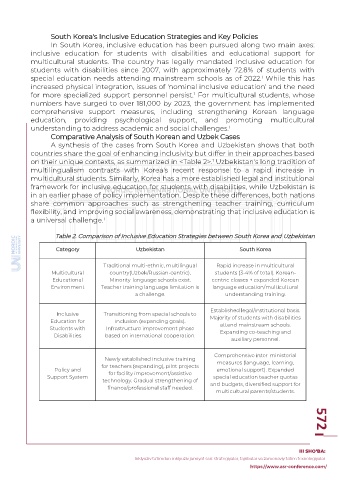
            on their unique contexts, as summarized in <Table 2>.  Uzbekistan's long tradition of
                                                                            1
            multilingualism  contrasts  with  Korea's  recent  response  to  a  rapid  increase  in
            multicultural students. Similarly, Korea has a more established legal and institutional
            framework for inclusive education for students with disabilities, while Uzbekistan is
            in an earlier phase of policy implementation. Despite these differences, both nations
            share  common  approaches  such  as  strengthening  teacher  training,  curriculum
            flexibility, and improving social awareness, demonstrating that inclusive education is
            a universal challenge.
                                     1

                    Table 2. Comparison of Inclusive Education Strategies between South Korea and Uzbekistan

                     Category                    Uzbekistan                          South Korea


                                     Traditional multi-ethnic, multilingual   Rapid increase in multicultural
                   Multicultural        country(Uzbek/Russian-centric).     students (3-4% of total). Korean-
                   Educational          Minority-language schools exist.   centric classes + expanded Korean
                   Environment       Teacher training language limitation is   language education/multicultural
                                                a challenge.                    understanding training.

                                                                           Established legal/institutional basis.
                     Inclusive        Transitioning from special schools to
                   Education for         inclusion (expanding goals).      Majority of students with disabilities
                   Students with      Infrastructure improvement phase        attend mainstream schools.
                    Disabilities      based on international cooperation.     Expanding co-teaching and
                                                                                  auxiliary personnel.

                                                                            Comprehensive inter-ministerial
                                      Newly established inclusive training   measures (language, learning,
                                     for teachers (expanding), pilot projects
                    Policy and         for facility improvement/assistive    emotional support). Expanded
                  Support System                                            special education teacher quotas
                                     technology. Gradual strengthening of   and budgets, diversified support for
                                       finance/professional staff needed.
                                                                             multicultural parents/students.


                                                                                                                572
                                                                                                          III SHO‘BA:

                                                Inklyuziv ta’limdan inklyuziv jamiyat sari: strategiyalar, tajribalar va zamonaviy ta’lim texnologiyalar

                                                                                         https://www.asr-conference.com/

