


Page 559 - XORIJIY TILLARNI O‘QITISH VA TARJIMA SOHASIDA SUN’IY INTELLEKTDAN SAMARALI FOYDALANISHNING ZAMONAVIY TENDENSIYALARI
P. 559
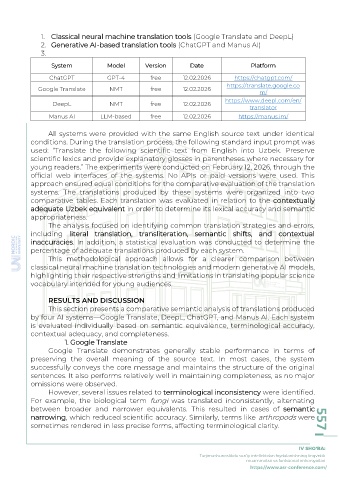
1.  Classical neural machine translation tools (Google Translate and DeepL)
               2.  Generative AI-based translation tools (ChatGPT and Manus AI)
               3.

                   System              Model        Version         Date                 Platform
                  ChatGPT              GPT-4          free       12.02.2026        https://chatgpt.com/
                                                                                 https://translate.google.co
              Google Translate         NMT            free       12.02.2026
                                                                                            m/
                                                                                https://www.deepl.com/en/
                    DeepL              NMT            free       12.02.2026
                                                                                         translator
                  Manus AI          LLM-based         free       12.02.2026          https://manus.im/

                  All systems were provided with the same English source text under identical
            conditions. During the translation process, the following standard input prompt was
            used:  “Translate  the  following  scientific  text  from  English  into  Uzbek.  Preserve
            scientific lexics and provide explanatory glosses in parentheses where necessary for
            young readers.” The experiments were conducted on February 12, 2026, through the
            official  web  interfaces  of  the  systems.  No  APIs  or  paid  versions  were  used.  This
            approach ensured equal conditions for the comparative evaluation of the translation
            systems.  The  translations  produced  by  these  systems  were  organized  into  two
            comparative  tables.  Each  translation  was  evaluated  in  relation  to  the  contextually
            adequate Uzbek equivalent in order to determine its lexical accuracy and semantic
            appropriateness.
                  The analysis focused on identifying common translation strategies and errors,
            including  literal  translation,  transliteration,  semantic  shifts,  and  contextual
            inaccuracies.  In  addition,  a  statistical  evaluation  was  conducted  to  determine  the
            percentage of adequate translations produced by each system.
                  This  methodological  approach  allows  for  a  clearer  comparison  between
            classical neural machine translation technologies and modern generative AI models,
            highlighting their respective strengths and limitations in translating popular science
            vocabulary intended for young audiences.

                  RESULTS AND DISCUSSION
                  This section presents a comparative semantic analysis of translations produced
            by four AI systems—Google Translate, DeepL, ChatGPT, and Manus AI. Each system
            is  evaluated  individually  based  on  semantic  equivalence,  terminological  accuracy,
            contextual adequacy, and completeness.
                        1. Google Translate
                  Google  Translate  demonstrates  generally  stable  performance  in  terms  of
            preserving  the  overall  meaning  of  the  source  text.  In  most  cases,  the  system
            successfully conveys the core message and maintains the structure of the original
            sentences. It also performs relatively well in maintaining completeness, as no major
            omissions were observed.
                  However, several issues related to terminological inconsistency were identified.
            For  example,  the  biological  term  fungi was  translated  inconsistently,  alternating

            between  broader  and  narrower  equivalents.  This  resulted  in  cases  of  semantic
            narrowing, which reduced scientific accuracy. Similarly, terms like arthropods                were   557
            sometimes rendered in less precise forms, affecting terminological clarity.


                                                                                                          IV SHO‘BA:

                                                                       Tarjimashunoslikda sun’iy intellektdan foydalanishning lingvistik
                                                                                       muammolari va funksional imkoniyatlari
                                                                                         https://www.asr-conference.com/

