


Page 561 - XORIJIY TILLARNI O‘QITISH VA TARJIMA SOHASIDA SUN’IY INTELLEKTDAN SAMARALI FOYDALANISHNING ZAMONAVIY TENDENSIYALARI
P. 561
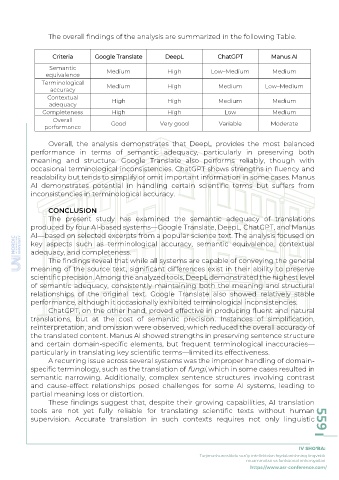
The overall findings of the analysis are summarized in the following Table.


                   Criteria       Google Translate         DeepL              ChatGPT           Manus AI
                  Semantic
                 equivalence          Medium                High           Low–Medium            Medium
                Terminological        Medium                High              Medium          Low–Medium
                   accuracy
                  Contextual
                  adequacy              High                High              Medium             Medium
                Completeness            High                High                Low              Medium
                    Overall
                 performance            Good             Very good            Variable          Moderate

                  Overall,  the  analysis  demonstrates  that  DeepL  provides  the  most  balanced
            performance  in  terms  of  semantic  adequacy,  particularly  in  preserving  both
            meaning  and  structure.  Google  Translate  also  performs  reliably,  though  with
            occasional terminological inconsistencies. ChatGPT shows strengths in fluency and
            readability but tends to simplify or omit important information in some cases. Manus
            AI  demonstrates  potential  in  handling  certain  scientific  terms  but  suffers  from
            inconsistencies in terminological accuracy.

                  CONCLUSION
                  The  present  study  has  examined  the  semantic  adequacy  of  translations
            produced by four AI-based systems—Google Translate, DeepL, ChatGPT, and Manus
            AI—based on selected excerpts from a popular science text. The analysis focused on
            key  aspects  such  as  terminological  accuracy,  semantic  equivalence,  contextual
            adequacy, and completeness.
                  The findings reveal that while all systems are capable of conveying the general
            meaning of the source text, significant differences exist in their ability to preserve
            scientific precision. Among the analyzed tools, DeepL demonstrated the highest level
            of semantic adequacy, consistently maintaining both the meaning and structural
            relationships  of  the  original  text.  Google  Translate  also  showed  relatively  stable
            performance, although it occasionally exhibited terminological inconsistencies.
                  ChatGPT, on the other hand, proved effective in producing fluent and natural
            translations,  but  at  the  cost  of  semantic  precision.  Instances  of  simplification,
            reinterpretation, and omission were observed, which reduced the overall accuracy of
            the translated content. Manus AI showed strengths in preserving sentence structure
            and  certain  domain-specific  elements, but  frequent  terminological  inaccuracies—
            particularly in translating key scientific terms—limited its effectiveness.
                  A recurring issue across several systems was the improper handling of domain-
            specific terminology, such as the translation of fungi, which in some cases resulted in
            semantic  narrowing.  Additionally,  complex  sentence  structures  involving  contrast
            and  cause-effect  relationships  posed  challenges  for  some  AI  systems,  leading  to
            partial meaning loss or distortion.
                  These findings suggest that, despite their growing capabilities, AI translation
            tools  are  not  yet  fully  reliable  for  translating  scientific  texts  without  human
            supervision.  Accurate  translation  in  such  contexts  requires  not  only  linguistic            559


                                                                                                          IV SHO‘BA:

                                                                       Tarjimashunoslikda sun’iy intellektdan foydalanishning lingvistik
                                                                                       muammolari va funksional imkoniyatlari
                                                                                         https://www.asr-conference.com/

