


Page 68 - J0JAPS_VOL14
P. 68
Shazrin Eqwal  / JOJAPS – JOURNAL ONLINE JARINGAN PENGAJIAN SENI BINA 0194955501
        3.0  RESEARCH DESIGN AND METHODOLOGY

           There are many methods that been use for the data analysis. However, previous researchers had used multiple regression
        analysis, first differences method, normality test, serial correlation test, and multicollinearity test.

        3.1     Sample and Population
           The  sample  for  this  paper  is  drawn  from  the  annual  data  set  of  World  Development  Indicators  through  World  Bank.
        Specifically, the sample included was Malaysia GDP per capita and trade openness data. For the GDP per capita, it is based on
        2000 U.S.D constant price annual data. And for the trade openness, it is generated from the summing up of export and import of
        goods and services of Malaysia.  For the data on financial openness, it is obtained from Lane & Milesi- Ferretti (2007), whereby
        it defined financial openness in term of GDP that has been transformed from country foreign asset and liabilities. By looking at
        this  data,  it  is  useful  to  measure  the  capital  account  openness  of  Malaysia.   Lastly,  for  the  data  on  the  institutions  and
        governance, it is obtained from World Governance Indicator (WGI). It is include all the interested independent variables which
        are political stability and absence of violence, government effectiveness, rules of law, and lastly regulatory quality. It also has
        been used by other previous researchers (Kaufmann, Kraay, & Mastruzzi, 2008).

        3.2     Hypothesis

        H 1 : There is a positive relationship between trade openness and Islamic Financial Market Development for Malaysia.
        H 2 : There is a positive relationship between rules of law with Islamic Financial Market Development for Malaysia.

        4.0     RESULTS AND DISCUSSION

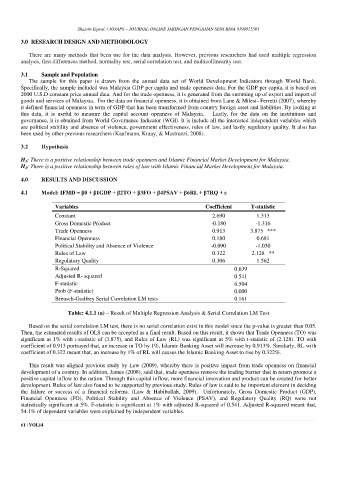
        4.1     Model: IFMD = β0 + β1GDP + β2TO + β3FO + β4PSAV + β6RL + β7RQ + ε

                    Variables                                            Coefficient     T-statistic
                    Constant                                                2.690          1.313
                    Gross Domestic Product                                 -0.180          -1.316
                    Trade Openness                                          0.913        3.875   ***
                    Financial Openness                                      0.180          0.681
                    Political Stability and Absence of Violence            -0.090          -1.030
                    Rules of Law                                            0.322        2.128   **
                    Regulatory Quality                                      0.306          1.562
                    R-Squared                                                      0.639
                    Adjusted R- squared                                            0.541
                    F-statistic                                                    6.504
                    Prob (F-statistic)                                             0.000
                    Breusch-Godfrey Serial Correlation LM tests                    0.161

                         Table: 4.1.1 (a) – Result of Multiple Regression Analysis & Serial Correlation LM Test

           Based on the serial correlation LM test, there is no serial correlation exist in this model since the p-value is greater than 0.05.
        Then, the estimated results of OLS can be accepted as a final result. Based on this result, it shows that Trade Openness (TO) was
        significant at 1% with t-statistic of (3.875), and Rules of Law (RL) was significant at 5% with t-statistic of (2.128). TO with
        coefficient of 0.913 portrayed that, an increase in TO by 1%, Islamic Banking Asset will increase by 0.913%. Similarly, RL with
        coefficient of 0.322 meant that, an increase by 1% of RL will causes the Islamic Banking Asset to rise by 0.322%.

           This result was aligned previous study by Law (2009), whereby there is positive impact from trade openness on financial
        development of a country. In addition, James (2008), said that, trade openness remove the trading barrier that in return promote a
        positive capital inflow to the nation. Through this capital inflow, more financial innovation and product can be created for better
        development. Rules of law also found to be supported by previous study. Rules of law is said to be important element in deciding
        the  failure  or  success  of  a  financial  reforms.  (Law  &  Habibullah,  2009).    Unfortunately,  Gross  Domestic  Product  (GDP),
        Financial  Openness  (FO),  Political  Stability  and  Absence  of  Violence  (PSAV),  and  Regulatory  Quality  (RQ)  were  not
        statistically significant at 5%. F-statistic is significant at 1% with adjusted R-squared of 0.541. Adjusted R-squared meant that,
        54.1% of dependent variables were explained by independent variables.

        61 | VOL14

