


Page 73 - J0JAPS_VOL14
P. 73
Widodo Puji  / JOJAPS – JOURNAL ONLINE JARINGAN PENGAJIAN SENI BINA
           The production failure occurs due  to shrinkage defect in  the cooling process. Regarding to the  most  failure products are
        caused  by  this  shrinkage,  the  research  on  the  effect  of  cooling  temperature  temperature  in  the  Injection  Molding  Process  is
        carried  out.  It  is  to  determine  the  effect  of  cooling  temperature  in  the  basic  product  shrinkage.  The  shrinkage  in  Injection
        Moulding  Process  is  functioned  to  keep  the  product  from  the  mold  that  can  cause  shrinkage  defect  or  out  of  specification
        products.

        2.0 LITERATURE REVIEW

        Anggono (2005) in the Mechanical Engineering Journal stated that plastic injection is a manufacture process to make a plastic
        base product or polypropylene. The process often makes defect products such as shrinkage, cracking, unsuitable dimensions, and
        damage when the products come out of the mold, also resulting in a lot of material waste. Defect products can be caused by some
        factors but the most important is shrinkage or material reduction.  Firdaus (2002) in the Mechanical Engineering Journal stated
        that shrinkage defect accurs when the melting temperature is too high. This defect can be reduced by designing the correct and
        proper parameters.  Moerbani (1999) stated that in every mold making, we should always count the occurrence of shrinkage after
        cooling temperature and after the products get out of the mold cavity. It happens because of the phase changes from the liquid
        material  to  solid  that  will  make  volume  change.  The  raw  material  that  is  used  to  produce  Upper  Thin  Wall  Square  is
        polyprophylene (PP) plastic. This material is included in the thermoplastic group. PP material is one of the derivative types of
        polymer. Polyprophylene (PP) raw material is obtained by decomposing petroleum (naphthan) by giving hydrogen gas petroleum
        at oil and natural gas splitting.


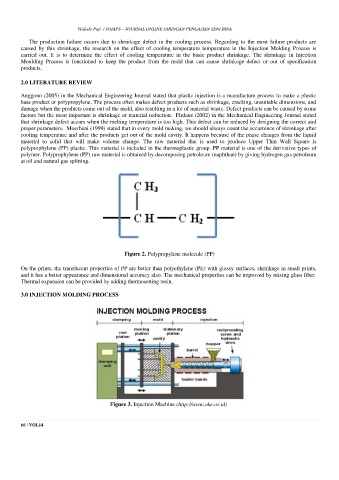
                                             Figure 2. Polypropylene molecule (PP)

        On the prints, the translucent properties of PP are better than polyethylene (PE) with glossy surfaces, shrinkage in small prints,
        and it has a better appearance and dimensional accuracy also. The mechanical properties can be improved by mixing glass fiber.
        Thermal expansion can be provided by adding thermosetting resin.

        3.0 INJECTION MOLDING PROCESS


                                        Figure 3. Injection Machine (http://www.oke.or.id)


        66 | VOL14

