


Page 76 - J0JAPS_VOL14
P. 76
Widodo Puji  / JOJAPS – JOURNAL ONLINE JARINGAN PENGAJIAN SENI BINA
        6.0 SHRINKAGE

           Shrinkage is a condition of deviation in the formation of plastic due to the cooling process that is not in accordance with the
        needs. The product making planner must count the existence of material shrinkage after the material or (workpiece) formed into a
        finished product. In the injection molding process, the heat treatment pressure will also affect the dimension of the product when
        it is compared to the size of the mold. Actual size of the product will be different, i.e. the size of the workpiece outside will be
        smaller than the cavity. The direction of material shrinkage leads to a reference point inside the workpiece, means, it can not take
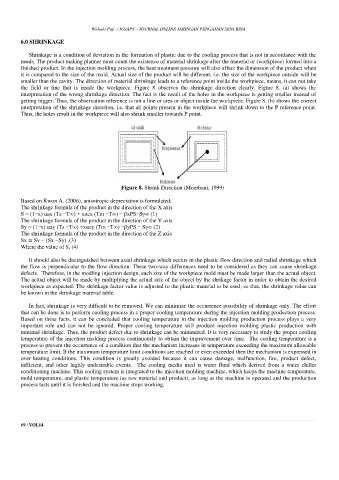
        the  field  or  line  that  is  inside  the  workpiece.  Figure  8  observes  the  shrinkage  direction  clearly.  Figure  8.  (a)  shows  the
        interpretation of the wrong shrinkage direction. The fact is the result of the holes in the workpiece is getting smaller instead of
        getting bigger. Thus, the observation reference is not a line or area or object inside the workpiece. Figure 8. (b) shows the correct
        interpretation of the shrinkage direction, i.e. that all points present in the workpiece will shrink down to the P reference point.
        Thus, the holes result in the workpiece will also shrink smaller towards P point.


                                            Figure 8. Shrink Direction (Moerbani, 1999)

        Based on Kwon A. (2006), anisotropic depreciation is formulated:
        The shrinkage formula of the product in the direction of the X axis
        S = (1−x) αax (Ts −T∞) + xαcx (Tm −T∞) − βxPS−Sγ∞ (1)
        The shrinkage formula of the product in the direction of the Y axis
        Sy = (1−x) αay (Ts −T∞) +xαcy (Tm −T∞) −βyPS − Sγ∞ (2)
        The shrinkage formula of the product in the direction of the Z axis
        Sx ≅ Sv − (Sx −Sy) .(3)
        Where the value of S, (4)

           It should also be distinguished between axial shrinkage which occurs in the plastic flow direction and radial shrinkage which
        the flow is perpendicular to the flow direction. These two-way differences need to be considered as they can cause shrinkage
        defects.  Therefore, in the modling injection design, each size of the workpiece mold must be made larger than the actual object.
        The actual object will be made by multiplying the actual size of the object by the shrikage factor in order to obtain the desired
        workpiece as expected. The shrinkage factor value is adjusted to the plastic material to be used, so that, the shrinkage value can
        be known in the shrinkage material table.

           In fact, shrinkage is very difficult to be removed. We can minimize the occurrence possibility of shrinkage only. The effort
        that can be done is to perform cooling process in a proper cooling temperature during the injection molding production process.
        Based on these  facts, it can  be concluded that cooling temperature in the injection  molding production process plays a  very
        important  role  and  can  not  be  ignored.  Proper  cooling  temperature  will  produce  injection  molding  plastic  production  with
        minimal shrinkage. Thus, the product defect due to shrinkage can be minimized. It is very necessary to study the proper cooling
        temperature of the injection molding process continuously to obtain the improvement over time.  The cooling temperature is a
        process to prevent the occurrence of a condition that the mechanism increases in temperature exceeding the maximum allowable
        temperature limit. If the maximum temperature limit conditions are reached or even exceeded then the mechanism is expressed in
        over-heating  conditions.  This  condition  is  greatly  avoided  because  it  can  cause  damage,  malfunction,  fire,  product  defect,
        infficient,  and  other  highly  undesirable  events.    The  cooling  media  used  is  water  fluid  which  derived  from  a  water  chiller
        conditioning machine. This cooling system is integrated to the injection molding machine, which keeps the machine temperature,
        mold temperature, and plastic temperature (as raw material and product), as long as the machine is operated and the production
        process lasts until it is finished and the machine stops working.


        69 | VOL14

