


Page 81 - J0JAPS_VOL14
P. 81
Fathan Mubina Dewadi  / JOJAPS – JOURNAL ONLINE JARINGAN PENGAJIAN SENI BINA

        That the material to be optimized, the HK-40 has a cheap price so that for the parameters related to price, this material is cheaper
        than the old material. With the existence of cheap and light prices, it can make scientists and researchers interested in being able
        to implement this research [5]. Formulation of the problem includes:
             1.  How to design lightweight E-bike frames and save electricity consumption?
             2.  What are the technical parameters of calculating E-bike frames that have renewal?
             3.  What material is suitable for E-bike frames in terms of economical and energy-saving aspects?

        This study has the objectives, namely:
            1.  To look for alternative model of frame that lightweight and save energy.
            2.  To find out the old frame data with a new frame so that the data obtained from these two frames can be used as  a
                comparison of the results of the data in both frames.
            3.  To get data optimization by having a lighter frame, so that it can save electricity on the battery.

        In conducting research on the E-bike frame, it is expected that it can produce something useful as follows:
            1.  Obtain data on old and new materials with analytical calculations.
            2.  To determine the operating load that is feasible to use in accordance with the material used / selected.
            3.  The results of this analysis are used as applications between existing materials and their lighting methods.

        In conducting research must understand the physical properties of the material because of the physical nature of the material as a
        support for the research base. Specifications of the physical properties of the material can be seen in Table 1.

                                          Table 1. Physical Properties of Materials [6].


        2.0 RESEARCH METHODS

        Research Materials
           In  this  study,  the  materials  used  in  the  study  were  batteries  and  electric  motors.  Li-ion  batteries  have  an  unmatchable
        combination of high energy and power density, making it the technology of choice for portable electronics, power tools, and
        hybrid/full electric vehicles. If electric vehicles (EVs) replace the majority of gasoline powered transportation, Li-ion batteries
        will significantly reduce greenhouse gas emissions. The high energy efficiency of Li-ion batteries may also allow their use in
        various electric grid applications, thus contributing to their more wide spread use and building an energy-sustainable economy.
        Therefore Li-ion bat-terries are of intense interest from both industry and government funding agencies, and research in this field
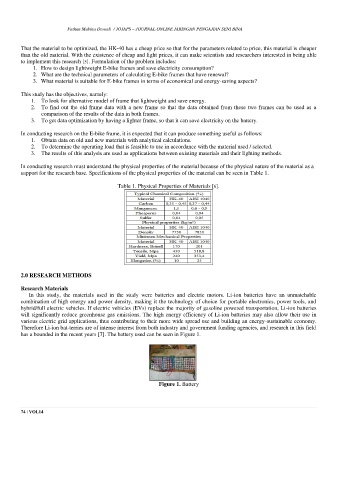
        has a bounded in the recent years [7]. The battery used can be seen in Figure 1.


                                                         Figure 1. Battery


        74 | VOL14

