


Page 56 - UNI 101 Computer Science Handout.
P. 56
Faculty of Nursing
                                                                  Adult care Nursing Department


             required. A few high-capacity optical disks could store all the medical records and history for a large

             insurance  company, for  example. Most  modern  programs  are  supplied on  DVD or  CD-ROM.  Of  the

             various secondary storage components, flash memory and disk devices are the fastest, since data can
             be accessed randomly. In fact, IBM refers to disks as direct access storage devices (DASDs). With tape, it

             may be necessary to search sequentially through a portion of the tape to find the desired data.


              Also, the disk rotates continuously, while the tape will have to start and stop, and possibly even reverse

             direction and rewind to find the desired data. These factors mean that tape is inherently slower unless
             the data is to be read sequentially. This makes tape suitable only for large-scale off-site backup storage

             where  the  entire  contents  of  a  disk  are  transferred  to  tape  to  protect  the  data  from  a  potential

             catastrophe or to meet legal long term data retention requirements. Although magnetic tape storage
             had large inherent cost and storage capacity advantages in the past, that is no longer the case, and the

             use of tape is decreasing as businesses replace their equipment with newer technology.


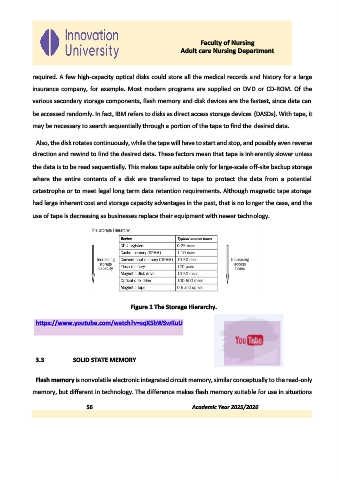
                                                Figure 1 The Storage Hierarchy.


              https://www.youtube.com/watch?v=sqX5bWSwKuU


              3.3          SOLID STATE MEMORY


              Flash memory is nonvolatile electronic integrated circuit memory, similar conceptually to the read-only

             memory, but different in technology. The difference makes flash memory suitable for use in situations

                                56                                                                        Academic Year 2025/2026

