


Page 59 - UNI 101 Computer Science Handout.
P. 59
Faculty of Nursing
                                                                  Adult care Nursing Department


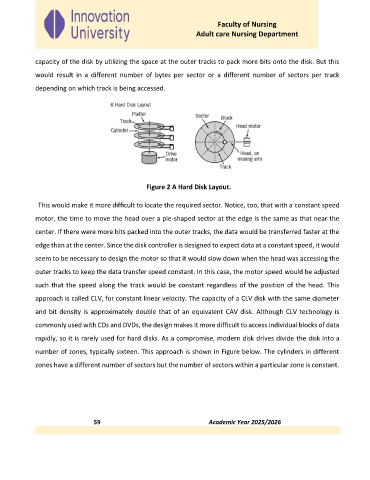
             capacity of the disk by utilizing the space at the outer tracks to pack more bits onto the disk. But this

             would  result  in  a  different  number  of  bytes  per  sector  or  a  different  number  of  sectors  per  track

             depending on which track is being accessed.


                                                 Figure 2 A Hard Disk Layout.


              This would make it more difficult to locate the required sector. Notice, too, that with a constant speed
             motor, the time to move the head over a pie-shaped sector at the edge is the same as that near the

             center. If there were more bits packed into the outer tracks, the data would be transferred faster at the

             edge than at the center. Since the disk controller is designed to expect data at a constant speed, it would

             seem to be necessary to design the motor so that it would slow down when the head was accessing the
             outer tracks to keep the data transfer speed constant. In this case, the motor speed would be adjusted

             such that the speed along the track would be constant regardless of the position of the head. This

             approach is called CLV, for constant linear velocity. The capacity of a CLV disk with the same diameter

             and bit density is approximately double that of an equivalent CAV disk. Although CLV technology is
             commonly used with CDs and DVDs, the design makes it more difficult to access individual blocks of data

             rapidly, so it is rarely used for hard disks. As a compromise, modern disk drives divide the disk into a

             number of zones, typically sixteen. This approach is shown in Figure below. The cylinders in different

             zones have a different number of sectors but the number of sectors within a particular zone is constant.


                                59                                                                        Academic Year 2025/2026

