


Page 63 - UNI 101 Computer Science Handout.
P. 63
Faculty of Nursing
                                                                  Adult care Nursing Department


              Once the sector is reached, the transfer of data can begin. Since the disk is rotating at a fixed speed,

             the time required to transfer the block, known as transfer time, is defined by the number of sectors on

             a track, since this establishes the percentage of the track that is used by a single data block. The transfer
             time is defined by


              Transfer time= 1/ (number of sectors × rotational speed)


              If the hard drive in the example contains 30 sectors per track, the transfer time for a single block would
             be


              Transfer time= 1/ (30×60) =0.55milliseconds


              Figure below shows a table of typical disks of different types, comparing various characteristics of the

             disks.  Since the  total  time  required  to  access a  disk block  is  approximately the  sum  of these three

             numbers, a typical disk access might require 20 to 25msec. To put these speeds in perspective, consider
             that the typical modern computer can execute an instruction in less than 1 nanosecond. Thus, the CPU

             is capable of executing millions of instructions in the time required for a single disk access. This should

             make it very clear to you that disk I/O is a major bottleneck in processing and also that it is desirable to
             find other work that the CPU can be doing while a program is waiting for disk I/O to take place.


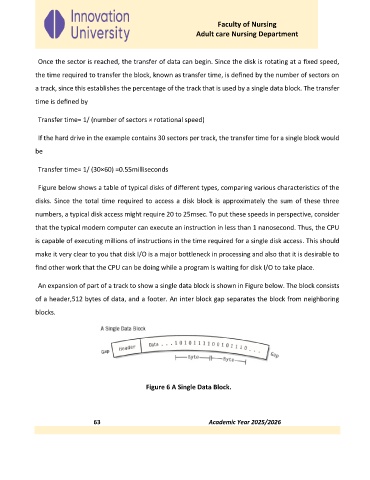
              An expansion of part of a track to show a single data block is shown in Figure below. The block consists

             of a header,512 bytes of data, and a footer. An inter block gap separates the block from neighboring

             blocks.


                                                 Figure 6 A Single Data Block.


                                63                                                                        Academic Year 2025/2026

