


Page 64 - UNI 101 Computer Science Handout.
P. 64
Faculty of Nursing
                                                                  Adult care Nursing Department


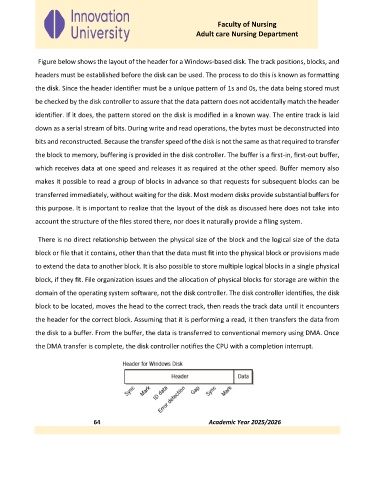
              Figure below shows the layout of the header for a Windows-based disk. The track positions, blocks, and

             headers must be established before the disk can be used. The process to do this is known as formatting

             the disk. Since the header identifier must be a unique pattern of 1s and 0s, the data being stored must
             be checked by the disk controller to assure that the data pattern does not accidentally match the header

             identifier. If it does, the pattern stored on the disk is modified in a known way. The entire track is laid

             down as a serial stream of bits. During write and read operations, the bytes must be deconstructed into
             bits and reconstructed. Because the transfer speed of the disk is not the same as that required to transfer

             the block to memory, buffering is provided in the disk controller. The buffer is a first-in, first-out buffer,

             which receives data at one speed and releases it as required at the other speed. Buffer memory also

             makes it possible to read a group of blocks in advance so that requests for subsequent blocks can be

             transferred immediately, without waiting for the disk. Most modern disks provide substantial buffers for
             this purpose. It is important to realize that the layout of the disk as discussed here does not take into

             account the structure of the files stored there, nor does it naturally provide a filing system.


              There is no direct relationship between the physical size of the block and the logical size of the data

             block or file that it contains, other than that the data must fit into the physical block or provisions made
             to extend the data to another block. It is also possible to store multiple logical blocks in a single physical

             block, if they fit. File organization issues and the allocation of physical blocks for storage are within the

             domain of the operating system software, not the disk controller. The disk controller identifies, the disk
             block to be located, moves the head to the correct track, then reads the track data until it encounters

             the header for the correct block. Assuming that it is performing a read, it then transfers the data from

             the disk to a buffer. From the buffer, the data is transferred to conventional memory using DMA. Once

             the DMA transfer is complete, the disk controller notifies the CPU with a completion interrupt.


                                64                                                                        Academic Year 2025/2026

