


Page 70 - UNI 101 Computer Science Handout.
P. 70
Faculty of Nursing
                                                                  Adult care Nursing Department


             underneath the other. Finally, a different manufacturing technique allows the use of both sides of a DVD.

             Each layer on a DVD can hold approximately 4.7 GB. If both layers on both sides are used, the DVD

             capacity  is  approximately  17  GB.  The  use  of  a  blue  laser  extends  this  capability  even  further,  to
             approximately 50 GB. WORM, or write-once-read-many-times, disks were originally designed to provide

             an inexpensive way for archiving data. WORM disks provide high-capacity storage with the convenience

             of compact size, reasonable cost, and removability. As the name indicates, WORM disks can be written,
             but, once written, a data block cannot be rewritten. The inability to tamper with the data on a WORM

             disk has taken on importance in business, where the permanence of many business data archives is

             required for legal purposes. When a file is updated, it is simply written again to a new block and a new

             directory entry is provided.

              Thus, a complete audit trail exists automatically. When the disk is filled, it is simply stored away and a

             new disk used. WORM disks work similarly to a CD or DVD. The major difference is that the disk is made

             of a material that can be blistered by a medium-power laser. Initially, the entire disk is smooth. When

             data is to be written, the medium-power laser creates tiny blisters in the appropriate locations. These

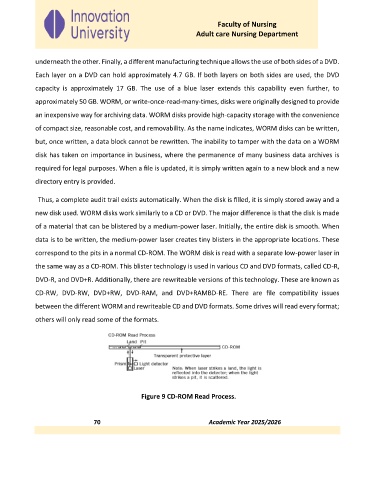
             correspond to the pits in a normal CD-ROM. The WORM disk is read with a separate low-power laser in
             the same way as a CD-ROM. This blister technology is used in various CD and DVD formats, called CD-R,

             DVD-R, and DVD+R. Additionally, there are rewriteable versions of this technology. These are known as

             CD-RW,  DVD-RW,  DVD+RW,  DVD-RAM,  and  DVD+RAMBD-RE.  There  are  file  compatibility  issues
             between the different WORM and rewriteable CD and DVD formats. Some drives will read every format;

             others will only read some of the formats.


                                                Figure 9 CD-ROM Read Process.


                                70                                                                        Academic Year 2025/2026

