


Page 72 - UNI 101 Computer Science Handout.
P. 72
Faculty of Nursing
                                                                  Adult care Nursing Department


              one-half inch wide tape in a 102mm × 105mm × 21.5mm cartridge. The technique used for storage and

             retrieval is called data streaming. The cartridge tape is divided longitudinally into many tracks, currently

             as many as 886. The tape mechanism writes and reads the bits longitudinally, along the length of one
             group of tracks. At each end, the tape reverses, and the next group of tracks are written or read. Data is

             usually stored on the tape starting with the centermost track and moving outward toward the edge of

             the tape. Error correction is built into the system, and WORM archiving is also available as an option. An
             alternative data cartridge format is based on the technology that was originally developed for videotape.

             These are called helical scan cartridges. The data on helical scan cartridges is very tightly packed, using

             a read/write head that rotates at a highspeed top ack the tape more tightly with data. This results in a

             track that is made up of diagonal lines across the width of the tape. There are two different helical scan

             cartridges in common use. The smaller AIT (advanced intelligent format) uses 8-mm wide tape in tape
             lengths of up to 246 meters, with a current maximum uncompressed capacity of 400 GB in a cartridge

             95mm×62.5×15mm. The larger SAIT (super-AIT) cartridge contains up to 640 meters of one-half inch

             wide tape, with a current maximum uncompressed capacity of 800 GB.


              The  SAIT  cartridge  is  the  same  size  as  the  LTO  cartridge,  but  the  two  types  of  cartridge  are  not
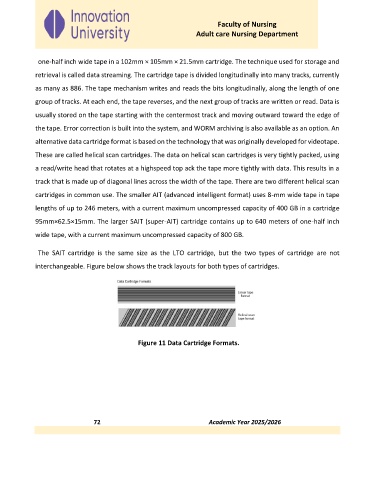
             interchangeable. Figure below shows the track layouts for both types of cartridges.


                                               Figure 11 Data Cartridge Formats.


                                72                                                                        Academic Year 2025/2026

