


Page 229 - Handout Computer Network.
P. 229
Computer Network                                                             2026


            In this section, we consider how one party can authenticate another party when the two are
            communicating over a network.

            We focus here on authenticating a “live” party, at the point in time when communication is
            actually occurring.
            A concrete example is a user authenticating him or herself to an e-mail server. This is a subtly
            different problem from proving that a message received at some point in the past did indeed
            come from that claimed sender.
            When performing authentication over the network, the communicating parties cannot rely on
            biometric information, such as a visual appearance or a voiceprint. Indeed, we will see in our
            later case studies that it is often network elements such as routers and client/server processes
            that must authenticate each other.

            Here, authentication must be done solely on the basis of messages and data exchanged as part
            of an authentication protocol. Typically, an authentication protocol would run before the two
            communicating parties run some other protocol (for example, a reliable data transfer protocol,
            a routing information exchange protocol, or an e-mail protocol).

            The  authentication  protocol  first  establishes  the  identities  of  the  parties  to  each  other’s
            satisfaction; only after authentication do the parties get down to the work at hand. As in the case
            of our development of a reliable data transfer (rdt) protocol, we will find it instructive here to
            develop various versions of an authentication protocol, which we will call ap (authentication
            protocol), and poke holes in each version as we proceed.
            (If you enjoy this stepwise evolution of a design, you might also enjoy [Bryant 1988], which
            recounts a fictitious narrative between designers of an open- network authentication system,
            and  their  discovery  of  the  many  subtle  issues  involved.)  Let’s  assume  that  Alice  needs  to
            authenticate herself to Bob.
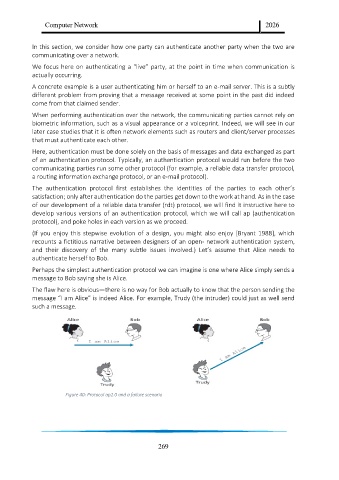
            Perhaps the simplest authentication protocol we can imagine is one where Alice simply sends a
            message to Bob saying she is Alice.

            The flaw here is obvious—there is no way for Bob actually to know that the person sending the
            message “I am Alice” is indeed Alice. For example, Trudy (the intruder) could just as well send
            such a message.


                        Figure 40: Protocol ap1.0 and a failure scenario


                                                         269

