


Page 234 - Handout Computer Network.
P. 234
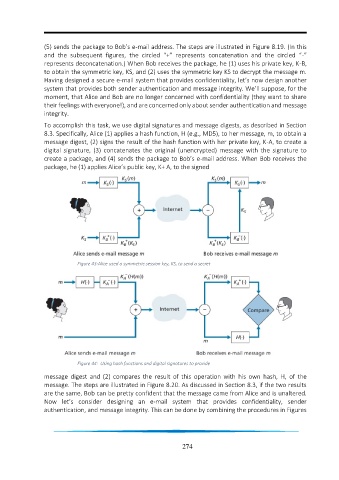
(5) sends the package to Bob’s e-mail address. The steps are illustrated in Figure 8.19. (In this
                 and  the  subsequent  figures,  the  circled  “+”  represents  concatenation  and  the  circled  “-”
                 represents deconcatenation.) When Bob receives the package, he (1) uses his private key, K-B,
                 to obtain the symmetric key, KS, and (2) uses the symmetric key KS to decrypt the message m.
                 Having designed a secure e-mail system that provides confidentiality, let’s now design another
                 system that provides both sender authentication and message integrity. We’ll suppose, for the
                 moment, that Alice and Bob are no longer concerned with confidentiality (they want to share
                 their feelings with everyone!), and are concerned only about sender authentication and message
                 integrity.

                 To accomplish this task, we use digital signatures and message digests, as described in Section
                 8.3. Specifically, Alice (1) applies a hash function, H (e.g., MD5), to her message, m, to obtain a
                 message digest, (2) signs the result of the hash function with her private key, K-A, to create a
                 digital  signature,  (3)  concatenates  the  original  (unencrypted)  message  with  the signature  to
                 create a package, and (4) sends the package to Bob’s e-mail address. When Bob receives the
                 package, he (1) applies Alice’s public key, K+ A, to the signed


                            Figure 43:Alice used a symmetric session key, KS, to send a secret


                            Figure 44:  Using hash functions and digital signatures to provide

                 message  digest  and  (2)  compares  the  result  of  this  operation  with  his  own  hash,  H,  of  the
                 message. The steps are illustrated in Figure 8.20. As discussed in Section 8.3, if the two results
                 are the same, Bob can be pretty confident that the message came from Alice and is unaltered.
                 Now  let’s  consider  designing  an  e-mail  system  that  provides  confidentiality,  sender
                 authentication, and message integrity. This can be done by combining the procedures in Figures


                                                                 274

