


Page 232 - Handout Computer Network.
P. 232
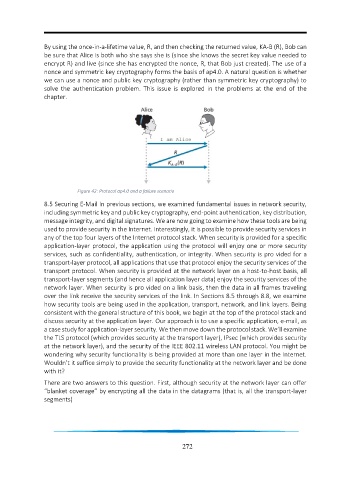
By using the once-in-a-lifetime value, R, and then checking the returned value, KA-B (R), Bob can
                 be sure that Alice is both who she says she is (since she knows the secret key value needed to
                 encrypt R) and live (since she has encrypted the nonce, R, that Bob just created). The use of a
                 nonce and symmetric key cryptography forms the basis of ap4.0. A natural question is whether
                 we can use a nonce and public key cryptography (rather than symmetric key cryptography) to
                 solve  the  authentication  problem.  This  issue  is  explored  in  the  problems  at  the  end  of  the
                 chapter.


                            Figure 42: Protocol ap4.0 and a failure scenario

                 8.5 Securing E-Mail In previous sections, we examined fundamental issues in network security,
                 including symmetric key and public key cryptography, end-point authentication, key distribution,
                 message integrity, and digital signatures. We are now going to examine how these tools are being
                 used to provide security in the Internet. Interestingly, it is possible to provide security services in
                 any of the top four layers of the Internet protocol stack. When security is provided for a specific
                 application-layer protocol, the application using the protocol will enjoy one or more security
                 services, such as confidentiality, authentication, or integrity. When security is pro vided for a
                 transport-layer protocol, all applications that use that protocol enjoy the security services of the
                 transport protocol. When security is provided at the network layer on a host-to-host basis, all
                 transport-layer segments (and hence all application layer data) enjoy the security services of the
                 network layer. When security is pro vided on a link basis, then the data in all frames traveling
                 over the link receive the security services of the link. In Sections 8.5 through 8.8, we examine
                 how security tools are being used in the application, transport, network, and link layers. Being
                 consistent with the general structure of this book, we begin at the top of the protocol stack and
                 discuss security at the application layer. Our approach is to use a specific application, e-mail, as
                 a case study for application-layer security. We then move down the protocol stack. We’ll examine
                 the TLS protocol (which provides security at the transport layer), IPsec (which provides security
                 at the network layer), and the security of the IEEE 802.11 wireless LAN protocol. You might be
                 wondering why security functionality is being provided at more than one layer in the Internet.
                 Wouldn’t it suffice simply to provide the security functionality at the network layer and be done
                 with it?
                 There are two answers to this question. First, although security at the network layer can offer
                 “blanket coverage” by encrypting all the data in the datagrams (that is, all the transport-layer
                 segments)


                                                                 272

