


Page 236 - Handout Computer Network.
P. 236
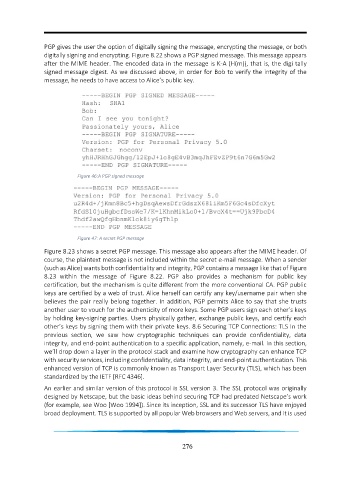
PGP gives the user the option of digitally signing the message, encrypting the message, or both
                 digitally signing and encrypting. Figure 8.22 shows a PGP signed message. This message appears
                 after the MIME header. The encoded data in the message is K-A (H(m)), that is, the digi tally
                 signed message digest. As we discussed above, in order for Bob to verify the integrity of the
                 message, he needs to have access to Alice’s public key.


                            Figure 46:A PGP signed message


                            Figure 47: A secret PGP message
                 Figure 8.23 shows a secret PGP message. This message also appears after the MIME header. Of
                 course, the plaintext message is not included within the secret e-mail message. When a sender
                 (such as Alice) wants both confidentiality and integrity, PGP contains a message like that of Figure
                 8.23  within  the  message  of  Figure  8.22.  PGP  also  provides  a  mechanism  for  public  key
                 certification, but the mechanism is quite different from the more conventional CA. PGP public
                 keys are certified by a web of trust. Alice herself can certify any key/username pair when she
                 believes the pair really belong together. In addition, PGP permits Alice to say that she trusts
                 another user to vouch for the authenticity of more keys. Some PGP users sign each other’s keys
                 by holding key-signing parties. Users physically gather, exchange public keys, and certify each
                 other’s keys by signing them with their private keys. 8.6 Securing TCP Connections: TLS In the
                 previous  section,  we  saw  how  cryptographic  techniques  can  provide  confidentiality,  data
                 integrity, and end-point authentication to a specific application, namely, e-mail. In this section,
                 we’ll drop down a layer in the protocol stack and examine how cryptography can enhance TCP
                 with security services, including confidentiality, data integrity, and end-point authentication. This
                 enhanced version of TCP is commonly known as Transport Layer Security (TLS), which has been
                 standardized by the IETF [RFC 4346].
                 An earlier and similar version of this protocol is SSL version 3. The SSL protocol was originally
                 designed by Netscape, but the basic ideas behind securing TCP had predated Netscape’s work
                 (for example, see Woo [Woo 1994]). Since its inception, SSL and its successor TLS have enjoyed
                 broad deployment. TLS is supported by all popular Web browsers and Web servers, and it is used


                                                                 276

