


Page 240 - Handout Computer Network.
P. 240
the record itself, but when he calculates the HMAC, he includes the sequence number in the
                 HMAC calculation. Thus, the HMAC is now a hash of the data plus the HMAC key MB plus the
                 current sequence number. Alice tracks Bob’s sequence numbers, allowing her to verify the data
                 integrity of a record by including the appropriate sequence number in the HMAC calculation. This
                 use of TLS sequence numbers prevents Trudy from carrying out a woman-in-the-middle attack,
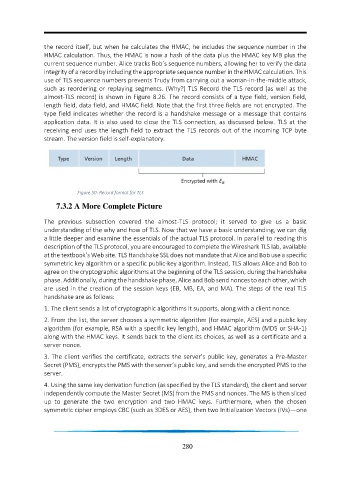
                 such as reordering or replaying segments. (Why?) TLS Record the TLS record (as well as the
                 almost-TLS record) is shown in Figure 8.26. The record consists of a type field, version field,
                 length field, data field, and HMAC field. Note that the first three fields are not encrypted. The
                 type field indicates whether the record is a handshake message or a message that contains
                 application  data.  It  is  also  used  to close  the  TLS  connection,  as  discussed  below.  TLS  at  the
                 receiving end uses the length field to extract the TLS records out of the incoming TCP byte
                 stream. The version field is self-explanatory.


                            Figure 50: Record format for TLS
                     7.3.2 A More Complete Picture


                 The  previous  subsection  covered  the  almost-TLS  protocol;  it  served  to  give  us  a  basic
                 understanding of the why and how of TLS. Now that we have a basic understanding, we can dig
                 a little deeper and examine the essentials of the actual TLS protocol. In parallel to reading this
                 description of the TLS protocol, you are encouraged to complete the Wireshark TLS lab, available
                 at the textbook’s Web site. TLS Handshake SSL does not mandate that Alice and Bob use a specific
                 symmetric key algorithm or a specific public-key algorithm. Instead, TLS allows Alice and Bob to
                 agree on the cryptographic algorithms at the beginning of the TLS session, during the handshake
                 phase. Additionally, during the handshake phase, Alice and Bob send nonces to each other, which
                 are used in the creation of the session keys (EB, MB, EA, and MA). The steps of the real TLS
                 handshake are as follows:

                 1. The client sends a list of cryptographic algorithms it supports, along with a client nonce.

                 2. From the list, the server chooses a symmetric algorithm (for example, AES) and a public key
                 algorithm (for example, RSA with a specific key length), and HMAC algorithm (MD5 or SHA-1)
                 along with the HMAC keys. It sends back to the client its choices, as well as a certificate and a
                 server nonce.

                 3. The client verifies the certificate, extracts the server’s public key, generates a Pre-Master
                 Secret (PMS), encrypts the PMS with the server’s public key, and sends the encrypted PMS to the
                 server.

                 4. Using the same key derivation function (as specified by the TLS standard), the client and server
                 independently compute the Master Secret (MS) from the PMS and nonces. The MS is then sliced
                 up  to  generate  the  two  encryption  and  two  HMAC  keys.  Furthermore,  when  the  chosen
                 symmetric cipher employs CBC (such as 3DES or AES), then two Initialization Vectors (IVs)—one


                                                                 280

