


Page 237 - Handout Computer Network.
P. 237
Computer Network                                                             2026


            by  Gmail  and  essentially  all  Internet  commerce sites  (including  Amazon,  eBay,  and  TaoBao).
            Hundreds of billions of dollars are spent over TLS every year. In fact, if you have ever purchased
            anything over the Internet with your credit card, the communication between your browser and
            the server for this purchase almost certainly went over TLS. (You can identify that TLS is being
            used by your browser when the URL begins with https: rather than http.)

            To understand the need for TLS, let’s walk through a typical Internet commerce scenario. Bob is
            surfing the Web and arrives at the Alice Incorporated site, which is selling perfume. The Alice
            Incorporated site displays a form in which Bob is supposed to enter the type of perfume and
            quantity desired, his address, and his payment card number. Bob enters this information, clicks
            on Submit, and expects to receive (via ordinary postal mail) the purchased perfumes; he also
            expects to receive a charge for his order in his next payment card statement. This all sounds
            good, but if no security measures are taken, Bob could be in for a few surprises.

            • If no confidentiality (encryption) is used, an intruder could intercept Bob’s order and obtain his
            payment card information. The intruder could then make purchases at Bob’s expense.
            • If no data integrity is used, an intruder could modify Bob’s order, having him purchase ten times
            more bottles of perfume than desired.

            • Finally, if no server authentication is used, a server could display Alice Incor porated’s famous
            logo when in actuality the site maintained by Trudy, who is masquerading as Alice Incorporated.
            After receiving Bob’s order, Trudy could take Bob’s money and run. Or Trudy could carry out an
            identity theft by collect ing Bob’s name, address, and credit card number. TLS addresses these
            issues by enhancing TCP with confidentiality, data integrity, server authentication, and client
            authentication.
            TLS is often used to provide security to transactions that take place over HTTP. However, because
            TLS secures TCP, it can be employed by any application that runs over TCP. TLS provides a simple
            Application Programmer Interface (API) with sockets, which is similar and analogous to TCP’s API.
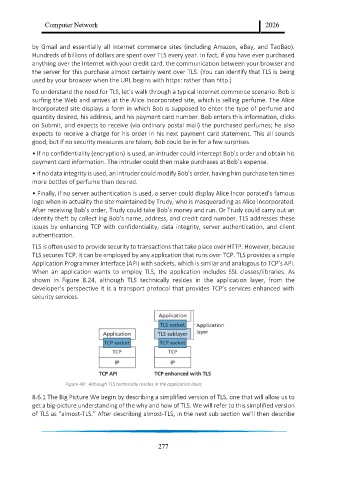
            When  an  application  wants  to  employ  TLS,  the  application  includes  SSL  classes/libraries.  As
            shown  in  Figure  8.24,  although  TLS  technically  resides  in  the  application  layer,  from  the
            developer’s perspective it is a transport protocol that provides TCP’s services enhanced with
            security services.


                        Figure 48:  Although TLS technically resides in the application layer,
            8.6.1 The Big Picture We begin by describing a simplified version of TLS, one that will allow us to
            get a big-picture understanding of the why and how of TLS. We will refer to this simplified version
            of TLS as “almost-TLS.” After describing almost-TLS, in the next sub section we’ll then describe


                                                         277

