


Page 17 - 05 Cotton SA March 2015
P. 17
Nuus • News
Nuus • News
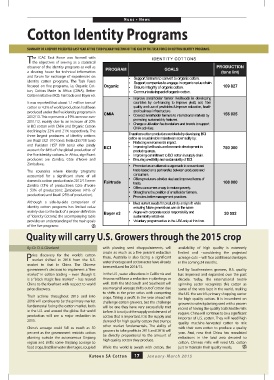
Cotton Identity Programs
SUMMARY OF A REPORT PRESENTED LAST YEAR AT THE 73RD PLENARY MEETING OF THE ICAC BY THE TASK FORCE ON COTTON IDENTITY PROGRAMS.
he ICAC Task Force was formed with IDENTITY COTTONS
Tthe objectives of serving as a statistical
observer of the identity programs as well as PROGRAM GOALS PRODUCTION
a clearing house for technical information (tons lint)
and forum for exchange of experiences on Support farmers to convert to organic cotton.
identity cotton programs. The Task Force Support companies to engage in organic value chain.
focused on five programs, i.e. Organic Cot- Organic Ensure integrity of organic cotton. 109 827
ton, Cotton Made in Africa (CMiA), Better Communicate impact of organic cotton.
Cotton Initiative (BCI), Fairtrade and Bayer e3.
Improve smallholder farmer livelihoods in developing
It was reported that about 1.1 million tons of countries by co-financing to improve yield, soil, fiber
cotton or 4.2% of world production had been quality and use of pesticides & improve education, health
produced under the five identity programs in CMiA and business infrastructure. 156 025
2012/13. This represents a 19% increase over Connect smallholder farmers to international markets by
2011/12, mainly due to an increase of 20% promoting sustainability features.
in BCI cotton with CMiA and Organic Cotton Charge a utilization fee to retailers and brands to support
CMiA activities.
declining by 22% and 21% respectively. The
three largest producers of identity cottons Transform cotton production worldwide by developing BCI
are Brazil (321 010 tons); India (255738 tons) cotton as a sustainable mainstream commodity by:
• Reducing environmental impact.
and Pakistan (157 000 tons) who jointly • Improving livelihoods and economic development in
account for 64% of the global production of BCI producing areas. 750 300
the five identity cottons. In Africa, significant • Improving commitment to BCI cotton in supply chain.
producers are Zambia, Côte d’Ivoire and • Ensuring credibility and sustainability of BCI.
Zimbabwe.
Promoted as an alternative approach to conventional
The countries where identity programs trade based on a partnership between producers and
accounted for a significant share of all consumers.
domestic cotton production in 2012/13 were: Fairtrade Offers producers a better deal and improved terms of 108 000
Zambia (73% of production); Côte d’Ivoire trade.
( 53% of production); Zimbabwe (41% of Offers consumers a way to reduce poverty.
production) and Brazil (25% of production). Strengthens the position of smallholder farmers.
Promotes better management practices.
Although a side-by-side comparison of Meet current needs for productivity and profit while
identity cotton programs has limited value ensuring future generations can do the same.
mainly due to the lack of a proper definition Bayer e3 Aligns with corporate social responsibility and 20 552
of ‘Identity Cottons’, the accompanying table sustainability initiatives.
provides an understanding of the main goals Voluntary program active in the USA only at this time.
of the five programs:
Quality will carry U.S. Growers through the 2015 crop
By: Dr. O. A. Cleveland with planting seed disappointments, will availability of high quality is extremely
create as much as a five percent reduction limited and –considering the projected
rice discovery for the world’s cotton there. Australia is also facing a significant
Pmarket shifted in 2014 from the U.S. water shortage and cotton acres have already acreage cuts – will face additional shortages
in the coming 24 months.
market to that in China. The Chinese been reduced for 2014/15.
government’s decision to implement a “free Led by Southwestern growers, U.S. quality
market” in cotton trading – even though it In the U.S., water allocations in California and has improved and expanded over the past
is a “black magic free market” – has moved Arizona will force a reduction in plantings as decade. Today, the international textile
China to the forefront with respect to world well. Both the Mid-South and Southeast will spinning sector recognizes this cotton as
price discovery. see marginal acreage shifts out of cotton due some of the very best in the world, making
to shifts in the price ratios with competing the U.S. the world’s primary shopping center
Their actions throughout 2015 and into crops. Taking a profit in the year ahead will for high quality cotton. It is incumbent on
2016 will continue to be the primary market challenge cotton growers, but the challenge growers to select planting seed with a proven
fundamental facing the cotton market, both will be one they have very successfully met record of having the quality traits textile mills
in the U.S. and around the globe. But world before. It is not just the supply and demand of
production will see a major reduction in cotton that is important. It is the supply and require. China will continue to be a significant
importer of U.S. cotton. They will need high
2015. demand for high quality cotton that trumps quality machine-harvested cotton to mix
other market fundamentals. The ability of
China’s acreage could fall as much as 30 with their own cotton to produce a quality
percent as the government restricts cotton growers to take profits in 2015 and 2016 will yarn. And, now that China has mandated
planting outside the autonomous Xinjiang be directly proportional to the amount of reductions in the land area devoted to
high quality cotton they produce.
region and shifts some Xinjiang acreage to cotton, Chinese mills will need U.S. cotton
food crops. Brazilian water shortages, coupled While the world is awash with cotton, the just to maintain their quality needs.
17
Ja
Katoen SA Cottontoen SA Cotton 17 Februarie • February 2014nuary-March 2015
Ka

