


Page 15 - 05 Cotton SA March 2015
P. 15
Nuus • News
                                                      Navorsing • Research
              Finding the right cultivar to plant


              at a particular planting time


              By Coleen Fourie, ARC Institute for Industrial   widen the window period for sowing and   The trial was conducted under irrigated
              Crops.                             ultimately optimize the total yield and   conditions, following practices that are
                                                 quality of fi bre.                 commonly used in commercial cotton
                                                                                    production systems.  The eff ect on
                                                 In 2013/14, a fi eld trial was conducted   planting time on plant growth, yield, fi bre
                     btaining a vigorous and optimal   at the ARC – Loskop Research Farm,   qualities and the degree of whiteness
                     stand is the fi rst step for   Groblersdal, by planting diff erent cotton   (colour values) of the diff erent cotton
                     profi table cotton production.                                 cultivars were determined.  The air and
             OThe use of appropriate cultivars   cultivars over a period of eight weeks to   soil temperatures were measured daily.
                                                 determine which cultivar is most suitable
              and agronomic practices in suitable                                   A soil temperature meter was installed
              environmental factors is a prerequisite for   for a particular planting date.  Seven cotton   on the 30th of September to record soil
              such success.  Environmental factors such   cultivars: three standards (Candia B2RF,   temperature during the sowing season of
              as soil temperature determines the time of   Delta12BRF and DP210BRF), three new   the eight planting dates.  Records on the air
              planting cotton.                   cultivars  (13P3001B2R2,  13P3005B2R2  temperature were obtained from the local
                                                 and Delta1240B2RF), and one Okra leaf   weather station.
              In South Africa, the window for sowing   (DP1441RF) were selected for this trial.  Each
              cotton in is very narrow and has a major   cultivar was planted weekly in the window   Cultivar  adaptation  and  successful
              infl uence on the yield and fi bre qualities.    period of 7 October 2013 to 25 November   production are infl uenced by climatic
              Finding the most suitable cultivar for   2013, making a total of 8 planting dates for   conditions, especially temperatures during
              a particular planting date can help to   each.                        specifi c phases of the growing season.  The
                                                                                    minimum and maximum temperature data
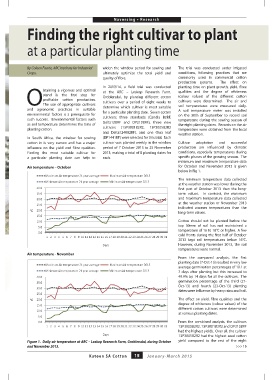
              Air temperature – October                                             for October and November 2013 is given
                                                                                    below in Fig 1.
                                                                                    The minimum temperature data collected
                                                                                    at the weather station was lower during the
                                                                                    fi rst part of October 2013 than the long-
                                                                                    term values.  In contrast, the minimum
                                                                                    and maximum temperature data collected
                                                                                    at the weather station or November 2013
                                                                                    indicated warmer temperatures than the
                                                                                    long-term values.

                                                                                    Cotton should not be planted before the
                                                                                    top 30mm of soil has not maintained a
                                                                                    temperature of 16 to 18°C or higher.  A few
                                                                                    cold fronts during the fi rst half of October
                                                                                    2013 kept soil temperatures below 16°C.
                                                                                    However, during November 2013, the soil
                                                                                    temperatures were normal.
                Air temperature - November
                                                                                    From the compared analysis, the fi rst
                                                                                    planting date (7-Oct-13) resulted in very low
                                                                                    average germination percentages of 10.1 at
                                                                                    7 days after planting but this increased to
                                                                                    49.9% by 14 days for all the cultivars.  The
                                                                                    germination percentage of the third (21-
                                                                                    Oct-13) and fourth (23-Oct-13) planting
                                                                                    dates were infl uence by heavy rains and hail.
                                                                                    The eff ect on yield, fi bre qualities and the
                                                                                    degree of whiteness (colour values) of the
                                                                                    diff erent cotton cultivars were determined
                                                                                    at various planting dates.

                                                                                    From the combined analysis, the cultivars
                                                                                    13P3005B2R2, 13P3001B2R2 and DP210BRF
                                                                                    had the highest yields.  Over all, the cultivar
                                                                                    13P3005B2R2 had the highest seed cotton
              Figure 1.  Daily air temperature at ARC – Loskop Research Farm, Groblersdal, during October   yield compared to the rest of the eight

              and November 2013.                                                                               >>> 16
                                           Katoen SA Cotton     15    January-March 2015

