


Page 247 - M. Abrahim Thesis
P. 247
Computer Network                                                             2026


             An SA is a simplex logical connection; that is, it is unidirectional from source to destination. If
            both entities want to send secure datagrams to each other, then two SAs (that is, two logical
            connections) need to be established, one in each direction. For example, consider once again the
            institutional VPN.

            This  institution  consists  of  a  headquarters  office,  a  branch  office  and,  say,  n  traveling
            salespersons.  For  the sake  of  example,  let’s  suppose  that  there  is bi-directional  IPsec  traffic
            between  headquarters  and  the  branch  office  and  bi-directional  IPsec  traffic  between
            headquarters and the salespersons. In this VPN, how many SAs are there?

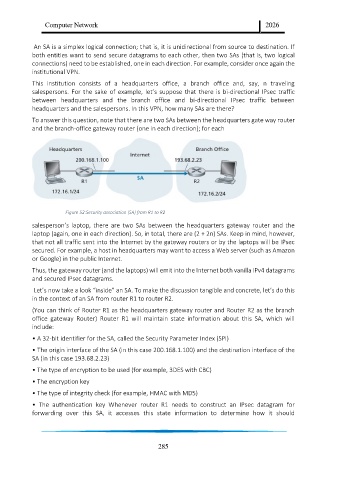
            To answer this question, note that there are two SAs between the headquarters gate way router
            and the branch-office gateway router (one in each direction); for each


                        Figure 52:Security association (SA) from R1 to R2

            salesperson’s  laptop,  there  are  two  SAs  between  the  headquarters  gateway  router  and  the
            laptop (again, one in each direction). So, in total, there are (2 + 2n) SAs. Keep in mind, however,
            that not all traffic sent into the Internet by the gateway routers or by the laptops will be IPsec
            secured. For example, a host in headquarters may want to access a Web server (such as Amazon
            or Google) in the public Internet.

            Thus, the gateway router (and the laptops) will emit into the Internet both vanilla IPv4 datagrams
            and secured IPsec datagrams.

             Let’s now take a look “inside” an SA. To make the discussion tangible and concrete, let’s do this
            in the context of an SA from router R1 to router R2.
            (You can think of Router R1 as the headquarters gateway router and Router R2 as the branch
            office  gateway  Router)  Router  R1  will  maintain  state  information  about  this  SA,  which  will
            include:

            • A 32-bit identifier for the SA, called the Security Parameter Index (SPI)
            • The origin interface of the SA (in this case 200.168.1.100) and the destination interface of the
            SA (in this case 193.68.2.23)
            • The type of encryption to be used (for example, 3DES with CBC)

            • The encryption key

            • The type of integrity check (for example, HMAC with MD5)
            •  The  authentication  key  Whenever  router  R1  needs  to  construct  an  IPsec  datagram  for
            forwarding  over  this  SA,  it  accesses  this  state  information  to  determine  how  it  should


                                                         285

