


Page 242 - M. Abrahim Thesis
P. 242
Chapter (3) Networking Media and Data Link Layers Protocols


                 record+HMAC. To create the HMAC, Bob inputs the record data along with the key MB into a
                 hash function, as discussed in Section 8.3.

                 To encrypt the package record+HMAC, Bob uses his session encryption key EB.
                 This encrypted package is then passed to TCP for transport over the Internet. Although this
                 approach goes a long way, it still isn’t bullet-proof when it comes to providing data integrity for
                 the entire message stream. In particular, suppose Trudy is a woman-in-the-middle and has the
                 ability to insert, delete, and replace segments in the stream of TCP segments sent between Alice
                 and Bob.
                 Trudy, for example, could capture two segments sent by Bob, reverse the order of the segments,
                 adjust the TCP sequence numbers (which are not encrypted), and then send the two reverse-
                 ordered segments to Alice. Assuming that each TCP segment encapsulates exactly one record,
                 let’s now take a look at how Alice would process these segments.
                 1.  TCP  running  in  Alice  would  think  everything  is  fine  and  pass  the  two  records  to  the  TLS
                 sublayer.

                 2. TLS in Alice would decrypt the two records.
                 3. TLS in Alice would use the HMAC in each record to verify the data integrity of the two records.

                 4. TLS would then pass the decrypted byte streams of the two records to the application layer;
                 but the complete byte stream received by Alice would not be in the correct order due to reversal
                 of the records! You are encouraged to walk through similar scenarios for when Trudy removes
                 segments  or  when  Trudy  replays  segments.  The  solution  to  this  problem,  as  you  probably
                 guessed, is to use sequence numbers.

                 TLS does this as follows. Bob maintains a sequence number counter, which begins at zero and is
                 incremented for each TLS record he sends. Bob doesn’t actually include a sequence number in
                 the record itself, but when he calculates the HMAC, he includes the sequence number in the
                 HMAC calculation. Thus, the HMAC is now a hash of the data plus the HMAC key MB plus the
                 current sequence number. Alice tracks Bob’s sequence numbers, allowing her to verify the data
                 integrity of a record by including the appropriate sequence number in the HMAC calculation. This
                 use of TLS sequence numbers prevents Trudy from carrying out a woman-in-the-middle attack,
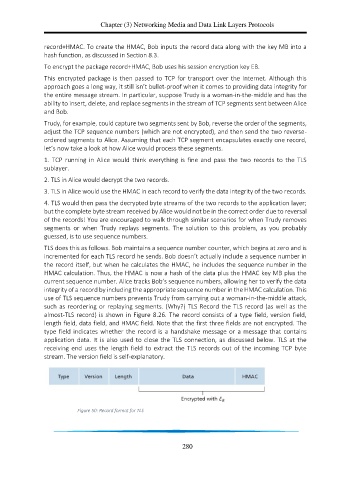
                 such as reordering or replaying segments. (Why?) TLS Record  the TLS record (as well as the
                 almost-TLS record) is shown in Figure 8.26. The record consists of a type field, version field,
                 length field, data field, and HMAC field. Note that the first three fields are not encrypted. The
                 type field indicates whether the record is a handshake message or a message that contains
                 application  data.  It  is  also  used  to close  the  TLS  connection,  as  discussed  below.  TLS  at  the
                 receiving end uses the length field to extract the TLS records out of the incoming TCP byte
                 stream. The version field is self-explanatory.


                            Figure 50: Record format for TLS


                                                                 280

