


Page 240 - M. Abrahim Thesis
P. 240
Chapter (3) Networking Media and Data Link Layers Protocols


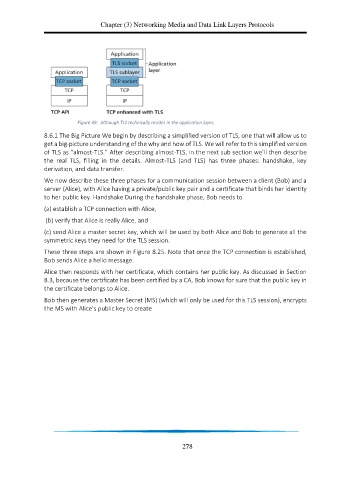
                            Figure 48:  Although TLS technically resides in the application layer,

                 8.6.1 The Big Picture We begin by describing a simplified version of TLS, one that will allow us to
                 get a big-picture understanding of the why and how of TLS. We will refer to this simplified version
                 of TLS as “almost-TLS.” After describing almost-TLS, in the next sub section we’ll then describe
                 the  real  TLS,  filling  in  the  details.  Almost-TLS  (and  TLS)  has  three  phases:  handshake,  key
                 derivation, and data transfer.

                 We now describe these three phases for a communication session between a client (Bob) and a
                 server (Alice), with Alice having a private/public key pair and a certificate that binds her identity
                 to her public key. Handshake During the handshake phase, Bob needs to
                 (a) establish a TCP connection with Alice,

                  (b) verify that Alice is really Alice, and
                 (c) send Alice a master secret key, which will be used by both Alice and Bob to generate all the
                 symmetric keys they need for the TLS session.
                 These three steps are shown in Figure 8.25. Note that once the TCP connection is established,
                 Bob sends Alice a hello message.

                 Alice then responds with her certificate, which contains her public key. As discussed in Section
                 8.3, because the certificate has been certified by a CA, Bob knows for sure that the public key in
                 the certificate belongs to Alice.
                 Bob then generates a Master Secret (MS) (which will only be used for this TLS session), encrypts
                 the MS with Alice’s public key to create


                                                                 278

