


Page 236 - M. Abrahim Thesis
P. 236
Chapter (3) Networking Media and Data Link Layers Protocols


                 impersonating Bob. So let’s begin by addressing the foremost concern, confidentiality. The most
                 straightforward way to provide confidentiality is for Alice to encrypt the message with symmetric
                 key technology (such as DES or AES) and for Bob to decrypt the message on receipt. As discussed
                 in Section 8.2, if the symmetric key is long enough, and if only Alice and Bob have the key, then
                 it is extremely difficult for anyone else (including Trudy) to read the message. Although this
                 approach is straightforward, it has the fundamental difficulty that we discussed in Section 8.2—
                 distributing a sym metric key so that only Alice and Bob have copies of it. So we naturally consider
                 an alternative approach—public key cryptography (using, for example, RSA). In the public key
                 approach,  Bob  makes  his  public  key  publicly  available  (e.g.,  in  a  public  key  server  or  on  his
                 personal  Web  page),  Alice  encrypts  her  message  with  Bob’s  public  key,  and  she  sends  the
                 encrypted message to Bob’s e-mail address. When Bob receives the message, he simply decrypts
                 it with his private key. Assuming that Alice knows for sure that the public key is Bob’s public key,
                 this  approach  is  an  excellent  means  to  provide  the  desired  confidentiality.  One  problem,
                 however, is that public key encryption is relatively inefficient, particularly for long messages. To
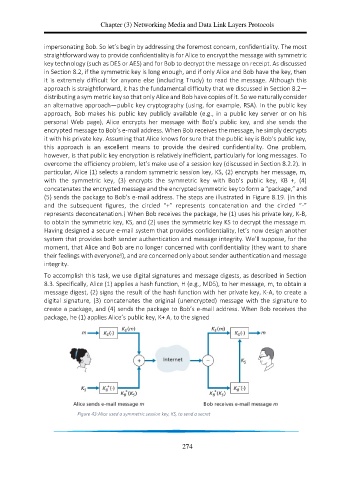
                 overcome the efficiency problem, let’s make use of a session key (discussed in Section 8.2.2). In
                 particular, Alice (1) selects a random symmetric session key, KS, (2) encrypts her message, m,
                 with  the  symmetric  key,  (3)  encrypts  the  symmetric  key  with  Bob’s  public  key,  KB  +,  (4)
                 concatenates the encrypted message and the encrypted symmetric key to form a “package,” and
                 (5) sends the package to Bob’s e-mail address. The steps are illustrated in Figure 8.19. (In this
                 and  the  subsequent  figures,  the  circled  “+”  represents  concatenation  and  the  circled  “-”
                 represents deconcatenation.) When Bob receives the package, he (1) uses his private key, K-B,
                 to obtain the symmetric key, KS, and (2) uses the symmetric key KS to decrypt the message m.
                 Having designed a secure e-mail system that provides confidentiality, let’s now design another
                 system that provides both sender authentication and message integrity. We’ll suppose, for the
                 moment, that Alice and Bob are no longer concerned with confidentiality (they want to share
                 their feelings with everyone!), and are concerned only about sender authentication and message
                 integrity.

                 To accomplish this task, we use digital signatures and message digests, as described in Section
                 8.3. Specifically, Alice (1) applies a hash function, H (e.g., MD5), to her message, m, to obtain a
                 message digest, (2) signs the result of the hash function with her private key, K-A, to create a
                 digital  signature,  (3)  concatenates  the  original  (unencrypted)  message  with  the  signature  to
                 create a package, and (4) sends the package to Bob’s e-mail address. When Bob receives the
                 package, he (1) applies Alice’s public key, K+ A, to the signed


                            Figure 43:Alice used a symmetric session key, KS, to send a secret


                                                                 274

