


Page 234 - M. Abrahim Thesis
P. 234
Chapter (3) Networking Media and Data Link Layers Protocols


                 connection if the received SYN segment was an old copy (retransmission) of a SYN segment from
                 an earlier connection. How did the TCP server side solve the problem of determining whether
                 the client was really live?

                 It chose an initial sequence number that had not been used in a very long time, sent that number
                 to the client, and then waited for the client to respond with an ACK segment containing that
                 number. We can adopt the same idea here for authentication purposes. A nonce is a number
                 that a protocol will use only once in a lifetime. That is, once a protocol uses a nonce, it will never
                 use that number again. Our ap4.0 protocol uses a nonce as follows:

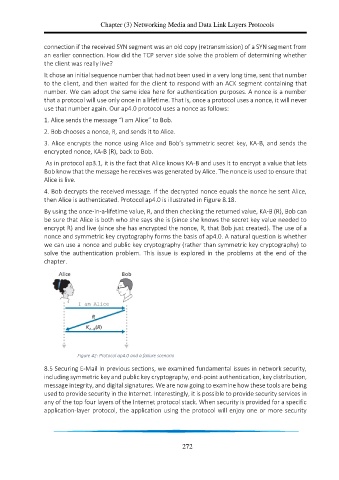
                 1. Alice sends the message “I am Alice” to Bob.
                 2. Bob chooses a nonce, R, and sends it to Alice.

                 3. Alice encrypts the nonce using Alice and Bob’s symmetric secret key, KA-B, and sends the
                 encrypted nonce, KA-B (R), back to Bob.
                  As in protocol ap3.1, it is the fact that Alice knows KA-B and uses it to encrypt a value that lets
                 Bob know that the message he receives was generated by Alice. The nonce is used to ensure that
                 Alice is live.
                 4. Bob decrypts the received message. If the decrypted nonce equals the nonce he sent Alice,
                 then Alice is authenticated. Protocol ap4.0 is illustrated in Figure 8.18.

                 By using the once-in-a-lifetime value, R, and then checking the returned value, KA-B (R), Bob can
                 be sure that Alice is both who she says she is (since she knows the secret key value needed to
                 encrypt R) and live (since she has encrypted the nonce, R, that Bob just created). The use of a
                 nonce and symmetric key cryptography forms the basis of ap4.0. A natural question is whether
                 we can use a nonce and public key cryptography (rather than symmetric key cryptography) to
                 solve  the  authentication  problem.  This  issue  is  explored  in  the  problems  at  the  end  of  the
                 chapter.


                            Figure 42: Protocol ap4.0 and a failure scenario
                 8.5 Securing E-Mail In previous sections, we examined fundamental issues in network security,
                 including symmetric key and public key cryptography, end-point authentication, key distribution,
                 message integrity, and digital signatures. We are now going to examine how these tools are being
                 used to provide security in the Internet. Interestingly, it is possible to provide security services in
                 any of the top four layers of the Internet protocol stack. When security is provided for a specific
                 application-layer protocol, the application using the protocol will enjoy one or more security


                                                                 272

