


Page 237 - M. Abrahim Thesis
P. 237
Computer Network                                                             2026


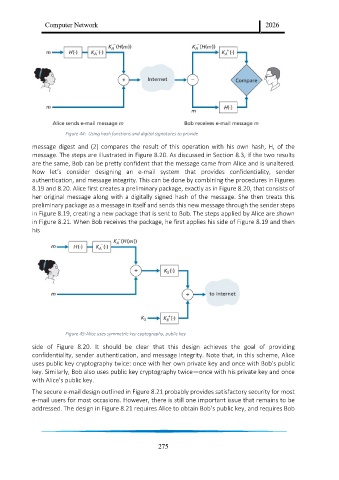
                        Figure 44:  Using hash functions and digital signatures to provide

            message  digest  and  (2)  compares  the  result  of  this  operation  with  his  own  hash,  H,  of  the
            message. The steps are illustrated in Figure 8.20. As discussed in Section 8.3, if the two results
            are the same, Bob can be pretty confident that the message came from Alice and is unaltered.
            Now  let’s  consider  designing  an  e-mail  system  that  provides  confidentiality,  sender
            authentication, and message integrity. This can be done by combining the procedures in Figures
            8.19 and 8.20. Alice first creates a preliminary package, exactly as in Figure 8.20, that consists of
            her original message along with a digitally signed hash of the message. She then treats this
            preliminary package as a message in itself and sends this new message through the sender steps
            in Figure 8.19, creating a new package that is sent to Bob. The steps applied by Alice are shown
            in Figure 8.21. When Bob receives the package, he first applies his side of Figure 8.19 and then
            his


                        Figure 45:Alice uses symmetric key cyptography, public key
            side  of  Figure  8.20.  It  should  be  clear  that  this  design  achieves  the  goal  of  providing
            confidentiality, sender authentication, and message integrity. Note that, in this scheme, Alice
            uses public key cryptography twice: once with her own private key and once with Bob’s public
            key. Similarly, Bob also uses public key cryptography twice—once with his private key and once
            with Alice’s public key.
            The secure e-mail design outlined in Figure 8.21 probably provides satisfactory security for most
            e-mail users for most occasions. However, there is still one important issue that remains to be
            addressed. The design in Figure 8.21 requires Alice to obtain Bob’s public key, and requires Bob


                                                         275

