


Page 238 - M. Abrahim Thesis
P. 238
Chapter (3) Networking Media and Data Link Layers Protocols


                 to obtain Alice’s public key. The distribution of these public keys is a nontrivial problem. For
                 example, Trudy might masquerade as Bob and give Alice her own public key while saying that it
                 is Bob’s public key, enabling her to receive the message meant for Bob. As we learned in Section
                 8.3, a popular approach for securely distributing public keys is to certify the public keys using a
                 CA.

                 8.5.2 PGP Written by Phil
                 Zimmermann in 1991, Pretty Good Privacy (PGP) is a nice exam ple of  an e-mail encryption
                 scheme [PGP 2020]. The PGP design is, in essence, the same as the design shown in Figure 8.21.
                 Depending on the version, the PGP software uses MD5 or SHA for calculating the message digest;
                 CAST, triple-DES, or IDEA for symmetric key encryption; and RSA for the public key encryption.
                 When PGP is installed, the software creates a public key pair for the user.

                 The public key can be posted on the user’s Web site or placed in a public key server. The private
                 key is protected by the use of a password.
                  The password has to be entered every time the user accesses the private key.

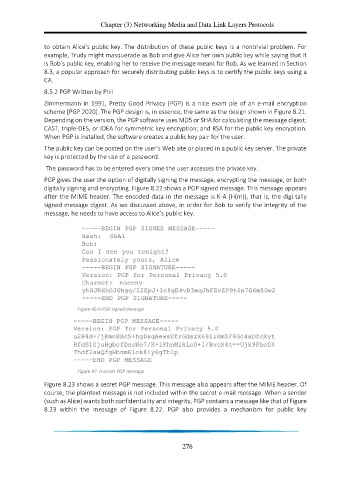
                 PGP gives the user the option of digitally signing the message, encrypting the message, or both
                 digitally signing and encrypting. Figure 8.22 shows a PGP signed message. This message appears
                 after the MIME header. The encoded data in the message is K-A (H(m)), that is, the digi tally
                 signed message digest. As we discussed above, in order for Bob to verify the integrity of the
                 message, he needs to have access to Alice’s public key.


                            Figure 46:A PGP signed message


                            Figure 47: A secret PGP message

                 Figure 8.23 shows a secret PGP message. This message also appears after the MIME header. Of
                 course, the plaintext message is not included within the secret e-mail message. When a sender
                 (such as Alice) wants both confidentiality and integrity, PGP contains a message like that of Figure
                 8.23  within  the  message  of  Figure  8.22.  PGP  also  provides  a  mechanism  for  public  key


                                                                 276

