


Page 5 - RJLJS - Legacy Program Black Version 2
P. 5
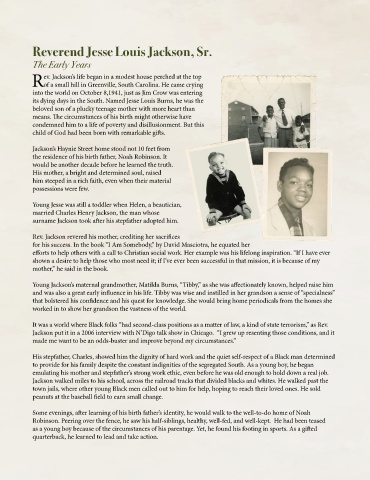
Reverend Jesse Louis Jackson, Sr.


            The Early Years

               ev. Jackson’s life began in a modest house perched at the top
            Rof a small hill in Greenville, South Carolina. He came crying
            into the world on October 8,1941, just as Jim Crow was entering
            its dying days in the South. Named Jesse Louis Burns, he was the
            beloved son of a plucky teenage mother with more heart than
            means. The circumstances of his birth might otherwise have
            condemned him to a life of poverty and disillusionment. But this
            child of God had been born with remarkable gifts.


            Jackson’s Haynie Street home stood not 10 feet from
            the residence of his birth father, Noah Robinson. It
            would be another decade before he learned the truth.
            His mother, a bright and determined soul, raised
            him steeped in a rich faith, even when their material
            possessions were few.

            Young Jesse was still a toddler when Helen, a beautician,
            married Charles Henry Jackson, the man whose
            surname Jackson took after his stepfather adopted him.

            Rev. Jackson revered his mother, crediting her sacrifices
            for his success. In the book “I Am Somebody,” by David Masciotra, he equated her
            efforts to help others with a call to Christian social work. Her example was his lifelong inspiration. “If I have ever
            shown a desire to help those who most need it; if I’ve ever been successful in that mission, it is because of my
            mother,” he said in the book.


            Young Jackson’s maternal grandmother, Matilda Burns, “Tibby,” as she was affectionately known, helped raise him
            and was also a great early influence in his life. Tibby was wise and instilled in her grandson a sense of “specialness”
            that bolstered his confidence and his quest for knowledge. She would bring home periodicals from the homes she
            worked in to show her grandson the vastness of the world.

            It was a world where Black folks “had second-class positions as a matter of law, a kind of state terrorism,” as Rev.
            Jackson put it in a 2006 interview with N’Digo talk show in Chicago.  “I grew up resenting those conditions, and it
            made me want to be an odds-buster and improve beyond my circumstances.”


            His stepfather, Charles, showed him the dignity of hard work and the quiet self-respect of a Black man determined
            to provide for his family despite the constant indignities of the segregated South. As a young boy, he began
            emulating his mother and stepfather’s strong work ethic, even before he was old enough to hold down a real job.
            Jackson walked miles to his school, across the railroad tracks that divided blacks and whites. He walked past the
            town jails, where other young Black men called out to him for help, hoping to reach their loved ones. He sold
            peanuts at the baseball field to earn small change.

            Some evenings, after learning of his birth father’s identity, he would walk to the well-to-do home of Noah
            Robinson. Peering over the fence, he saw his half-siblings, healthy, well-fed, and well-kept.  He had been teased
            as a young boy because of the circumstances of his parentage. Yet, he found his footing in sports. As a gifted
            quarterback, he learned to lead and take action.

