


Page 9 - RJLJS - Legacy Program Black Version 2
P. 9
In 1964, Jackson enrolled in the Chicago Theological   Operation Breadbasket and PUSH
 Seminary, a more white, progressive institution, but
 deferred his studies to work full-time with Dr. King. Jackson   Creating a Legacy
 later completed his education and was ordained on June 30,
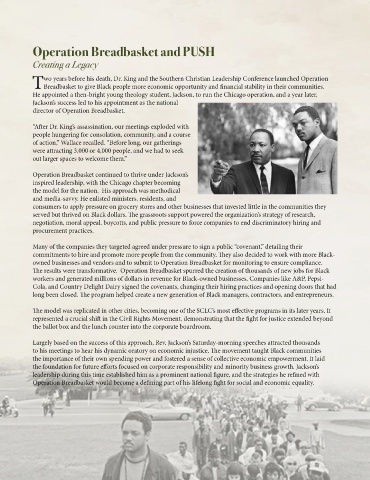
 1968. He received a Master of Divinity degree from Chicago   wo years before his death, Dr. King and the Southern Christian Leadership Conference launched Operation
 Theological Seminary in 2000.  TBreadbasket to give Black people more economic opportunity and financial stability in their communities.
            He appointed a then-bright young theology student, Jackson, to run the Chicago operation, and a year later,
 The push and pull between Rev. Jackson’s activist   Jackson’s success led to his appointment as the national
 inclinations and the scholarly theological teachings forced   director of Operation Breadbasket.
 him to develop a powerful dual consciousness. “Those who
 speak English cannot understand theological jargon,” he   “After Dr. King’s assassination, our meetings exploded with
 once said. “To me, it was always a struggle to take the best   people hungering for consolation, community, and a course
 of theological thought process and apply it onto and affirm   of action,” Wallace recalled. “Before long, our gatherings
 our culture.”   were attracting 3,000 or 4,000 people, and we had to seek
            out larger spaces to welcome them.”
 That would be the foundation of his determination to bring
 the ministry to everyday people. In the 1986 biography,   Operation Breadbasket continued to thrive under Jackson’s
 “Up With Hope,” the reverend recalled Tibby telling   inspired leadership, with the Chicago chapter becoming
 him, “Promise me you’ll be somebody.” Jackson not only   the model for the nation.  His approach was methodical
 delivered on that promise but also put the spotlight on   and media-savvy. He enlisted ministers, residents, and
 countless somebodies around the world with his mantra,   consumers to apply pressure on grocery stores and other businesses that invested little in the communities they
 “I Am Somebody” with the mantra, “I Am Somebody,”   served but thrived on Black dollars. The grassroots support powered the organization’s strategy of research,
 according to the Rev. Al Sharpton. Behind him was a life of   negotiation, moral appeal, boycotts, and public pressure to force companies to end discriminatory hiring and
 poverty, shame, and longing. Ahead of him was the promise of history and hope—a chance to be somebody.  procurement practices.

 Following Rosa Parks’ death, Rev. Jackson said, “History is marked as before and after Rosa Parks.” The same can   Many of the companies they targeted agreed under pressure to sign a public “covenant,” detailing their
 be said of Jackson’s indelible mark on the world stage.   commitments to hire and promote more people from the community. They also decided to work with more Black-
            owned businesses and vendors and to submit to Operation Breadbasket for monitoring to ensure compliance.
  His legacy is one of profound leadership that has aided in moving America forward and addressing the questions   The results were transformative.  Operation Breadbasket spurred the creation of thousands of new jobs for Black
 of racism and discrimination, said U.S. Rep. Maxine Waters. “It was Jesse Jackson’s leadership, along with the other   workers and generated millions of dollars in revenue for Black-owned businesses. Companies like A&P, Pepsi-
 greats, that really created change, and the movement toward opening up America to all,” Rep. Waters said.  Cola, and Country Delight Dairy signed the covenants, changing their hiring practices and opening doors that had
            long been closed. The program helped create a new generation of Black managers, contractors, and entrepreneurs.
 Rev. Jackson was at seminary school studying for final exams during the protest in Selma on March 7, 1965, that
 became known as “Bloody Sunday.” Alabama state troopers had savaged 600 people marching for voting rights on   The model was replicated in other cities, becoming one of the SCLC’s most effective programs in its later years. It
 the Edmund Pettus Bridge that horrendous day. Jackson was sickened by the images broadcast across the nation   represented a crucial shift in the Civil Rights Movement, demonstrating that the fight for justice extended beyond
 from Selma on the nightly news.  the ballot box and the lunch counter into the corporate boardroom.


 “When he heard the news, Jesse came to my room, very distraught,” said his classmate, David Wallace, who would   Largely based on the success of this approach, Rev. Jackson’s Saturday-morning speeches attracted thousands
 become his lifelong friend. Their seminary president urged them to remain at school to continue studying for   to his meetings to hear his dynamic oratory on economic injustice. The movement taught Black communities
 finals, but they were undeterred.  “See you in Selma,” we told him—and we did.”  the importance of their own spending power and fostered a sense of collective economic empowerment. It laid
            the foundation for future efforts focused on corporate responsibility and minority business growth. Jackson’s
 They organized a caravan of dozens of cars bringing protestors, students, and professors to join the 50,000   leadership during this time established him as a prominent national figure, and the strategies he refined with
 demonstrators converging on Selma in response to the brutal police attack. In a powerful show of unity, Jackson   Operation Breadbasket would become a defining part of his lifelong fight for social and economic equality.
 and Wallace helped organize another march that became known as “Turnaround Tuesday.” Their efforts in
 Alabama expanded to Montgomery, resulting in some of the most treacherous moments of the movement.

 Three years later, Rev. Jackson found himself once again in the center of one of the saddest days in America. He
 was at the Lorraine Motel when the Rev. Martin Luther King Jr. was assassinated. It was a devastating blow, but
 Rev. Jackson was determined not to let his grief over Dr. King’s death deter his resolve or diminish his faith. Rather,
 he continued the work they had begun with renewed urgency and mission, particularly through the “Operation
 Breadbasket” economic justice program.

