


Page 7 - RJLJS - Legacy Program Black Version 2
P. 7
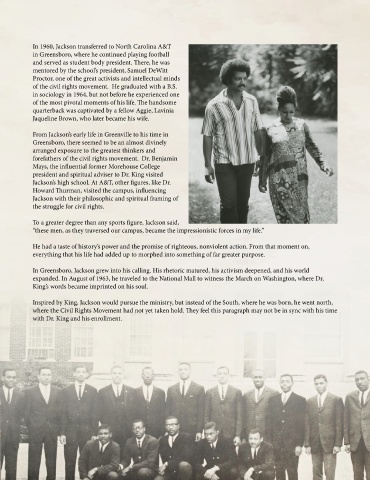
It was also where he learned how to speak with   In 1960, Jackson transferred to North Carolina A&T
 authority and clarity in the midst of chaos, he once said.   in Greensboro, where he continued playing football
 Later, as a leader in the civil rights struggle, he would   and served as student body president. There, he was
 say: “I’m still calling plays every minute, every hour,   mentored by the school’s president, Samuel DeWitt
 every day.”  Proctor, one of the great activists and intellectual minds
            of the civil rights movement.  He graduated with a B.S.
 Jackson grew out of a stutter that he discovered   in sociology in 1964, but not before he experienced one
 disappeared when he spoke to large groups. In church,   of the most pivotal moments of his life. The handsome
 he was transfixed by the power of the gospel and the   quarterback was captivated by a fellow Aggie, Lavinia
 voices of the congregation, lifted up in a unified call-  Jaqueline Brown, who later became his wife.
 and-response. Soon, he became a regular speaker at the
 Long Branch Baptist Church in his hometown, where   From Jackson’s early life in Greenville to his time in
 he nurtured his ability to move the flock with his words.  Greensboro, there seemed to be an almost divinely
            arranged exposure to the greatest thinkers and
 Jackson’s ticket out of Greenville came in the form   forefathers of the civil rights movement.  Dr. Benjamin
 of his talent as an athlete. Following his graduation   Mays, the influential former Morehouse College
 from Sterling High School in 1959, he attended the   president and spiritual adviser to Dr. King visited
 University of Illinois Urbana-Champaign on a football   Jackson’s high school. At A&T, other figures, like Dr.
 scholarship. Jackson quickly realized, though, that the   Howard Thurman, visited the campus, influencing
 cold and the social isolation did not suit him.   Jackson with their philosophic and spiritual framing of
            the struggle for civil rights.
 Around that time, activism was spreading rapidly
 among young Black students. Greenville could not   To a greater degree than any sports figure, Jackson said,
 escape the relentless push to move Jim Crow into the   “these men, as they traversed our campus, became the impressionistic forces in my life.”
 dustpan of history. Even famed baseball icon Jackie
 Robinson was warned by local whites to learn his place   He had a taste of history’s power and the promise of righteous, nonviolent action. From that moment on,
 when he visited Greenville in the fall of 1959.   everything that his life had added up to morphed into something of far greater purpose.

            In Greensboro, Jackson grew into his calling. His rhetoric matured, his activism deepened, and his world
            expanded. In August of 1963, he traveled to the National Mall to witness the March on Washington, where Dr,
            King’s words became imprinted on his soul.


            Inspired by King, Jackson would pursue the ministry, but instead of the South, where he was born, he went north,
            where the Civil Rights Movement had not yet taken hold. They feel this paragraph may not be in sync with his time
            with Dr. King and his enrollment.


 That episode touched off a flurry of activism in the
 otherwise sleepy town. And when Jackson returned
 home, he caught the spirit too. He organized a group
 of young people – the Greenville Eight, as they were
 later known – to stage a sit-in at the local library. Black
 residents were not permitted to check out books there
 until the Greenville Eight led the efforts that forced it
 to integrate. Jackson was arrested during one of the
 demonstrations and bailed out of the local jail for $30
 after word reached his mother on the local news. In that
 one heart-pounding instant, Rev. Jackson lost his fear of
 jails and gained his thirst for justice.

