


Page 22 - demo
P. 22
Noxious Plants


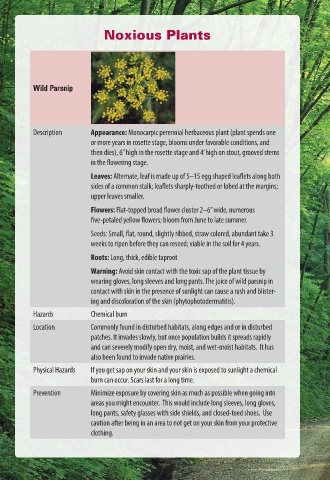
         Wild Parsnip


         Description   Appearance: Monocarpic perennial herbaceous plant (plant spends one
                       or more years in rosette stage, blooms under favorable conditions, and
                       then dies), 6” high in the rosette stage and 4’ high on stout, grooved stems
                       in the flowering stage.
                       Leaves: Alternate, leaf is made up of 5–15 egg shaped leaflets along both
                       sides of a common stalk; leaflets sharply-toothed or lobed at the margins;
                       upper leaves smaller.
                       Flowers: Flat-topped broad flower cluster 2–6” wide, numerous
                       five-petaled yellow flowers; bloom from June to late summer.
                       Seeds: Small, flat, round, slightly ribbed, straw colored, abundant take 3
                       weeks to ripen before they can reseed; viable in the soil for 4 years.
                       Roots: Long, thick, edible taproot
                       Warning: Avoid skin contact with the toxic sap of the plant tissue by
                       wearing gloves, long sleeves and long pants. The juice of wild parsnip in
                       contact with skin in the presence of sunlight can cause a rash and blister-
                       ing and discoloration of the skin (phytophotodermatitis).
         Hazards       Chemical burn
         Location      Commonly found in disturbed habitats, along edges and or in disturbed
                       patches. It invades slowly, but once population builds it spreads rapidly
                       and can severely modify open dry, moist, and wet-moist habitats.  It has
                       also been found to invade native prairies.
         Physical Hazards  If you get sap on your skin and your skin is exposed to sunlight a chemical
                       burn can occur. Scars last for a long time.
         Prevention    Minimize exposure by covering skin as much as possible when going into
                       areas you might encounter.  This would include long sleeves, long gloves,
                       long pants, safety glasses with side shields, and closed-toed shoes.  Use
                       caution after being in an area to not get on your skin from your protective
                       clothing.

