


Page 24 - demo
P. 24
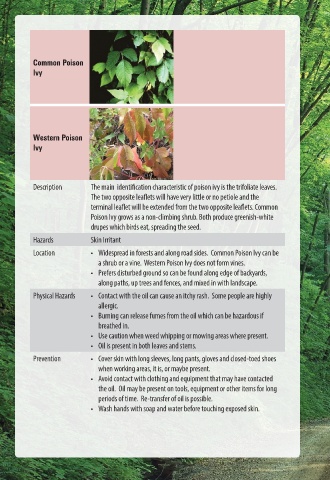
Common Poison
         Ivy


         Western Poison
         Ivy


         Description   The main  identification characteristic of poison ivy is the trifoliate leaves.
                       The two opposite leaflets will have very little or no petiole and the
                       terminal leaflet will be extended from the two opposite leaflets. Common
                       Poison Ivy grows as a non-climbing shrub. Both produce greenish-white
                       drupes which birds eat, spreading the seed.
         Hazards       Skin Irritant
         Location      •  Widespread in forests and along road sides.  Common Poison Ivy can be
                         a shrub or a vine.  Western Poison Ivy does not form vines.
                       •  Prefers disturbed ground so can be found along edge of backyards,
                         along paths, up trees and fences, and mixed in with landscape.
         Physical Hazards  •  Contact with the oil can cause an itchy rash.  Some people are highly
                         allergic.
                       •  Burning can release fumes from the oil which can be hazardous if
                         breathed in.
                       •  Use caution when weed whipping or mowing areas where present.
                       •  Oil is present in both leaves and stems.
         Prevention    •  Cover skin with long sleeves, long pants, gloves and closed-toed shoes
                         when working areas, it is, or maybe present.
                       •  Avoid contact with clothing and equipment that may have contacted
                         the oil.  Oil may be present on tools, equipment or other items for long
                         periods of time.  Re-transfer of oil is possible.
                       •  Wash hands with soap and water before touching exposed skin.

