


Page 40 - 2020 September 21 Elegant Embellishment the RenLu Colelction, Bonham NYC
P. 40
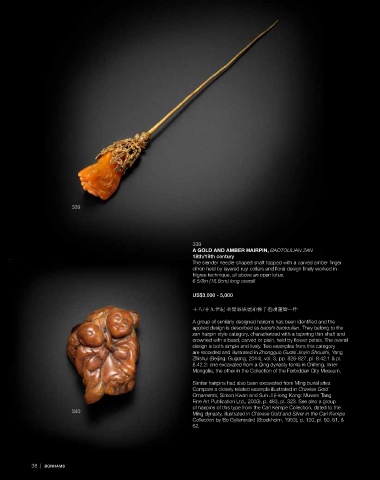
339


                                                             339
                                                             A GOLD AND AMBER HAIRPIN, BAOTOULIAN ZAN
                                                             18th/19th century
                                                             The slender needle-shaped shaft topped with a carved amber finger
                                                             citron held by layered ruyi collars and floral design finely worked in
                                                             filigree technique, all above an open lotus.
                                                             6 5/8in (16.8cm) long overall

                                                             US$3,000 - 5,000

                                                             十八/十九世紀 金纍絲嵌琥珀佛手抱頭蓮簪一件

                                                             A group of similarly designed hairpins has been identified and the
                                                             applied design is described as baoshi baotoulian. They belong to the
                                                             zan hairpin style category, characterized with a tapering thin shaft and
                                                             crowned with a bead, carved or plain, held by flower petals. The overall
                                                             design is both simple and lively. Two examples from this category
                                                             are recorded and illustrated in Zhongguo Gudai Jinyin Shoushi, Yang
                                                             Zhishui (Beijing: Gugong, 2014), vol. 3, pp. 826-827, pl. 8.42.1 & pl.
                                                             8.42.2: one excavated from a Qing dynasty tomb in Chifeng, Inner
                                                             Mongolia, the other in the Collection of the Forbidden City Museum.

                                                             Similar hairpins had also been excavated from Ming burial sites.
                                                             Compare a closely related example illustrated in Chinese Gold
                                                             Ornaments, Simon Kwan and Sun Ji (Hong Kong: Muwen Tang
                                                             Fine Art Publication Ltd., 2003), p. 483, pl. 323. See also a group
                                                             of hairpins of this type from the Carl Kempe Collection, dated to the
                        340                                  Ming dynasty, illustrated in Chinese Gold and Silver in the Carl Kempe
                                                             Collection by Bo Gyllensvärd (Stockholm, 1953), p. 120, pl. 60, 61, &
                                                             62.


           38  |  BONHAMS

